Sunday, May 22, 2022

Beach House Summer

Beach House Summer
Title:
  Beach House Summer
Author:  Sarah Morgan
Publication Information:  HQN. 2022. 384 pages.
ISBN:  133542752X / 978-1335427526

Book Source:  I received this book through NetGalley and The HTP Books Summer 2022 Beach Reads Blog Tour free of cost in exchange for an honest review.

Opening Sentence:  "She slid into his car, hoping this wasn't a mistake."

Favorite Quote:  "There are plenty of people out there who will make you think you're not good enough. That you should think small. Play it safe. Be less than you're capable of being. The important thing is not to believe them. If there's something you badly want to do, if you have a dream, you owe it to yourself to give it a try."

***** BLOG TOUR *****


Review

This is a feel good book that begins sadly with an accident and a violent death. It leads to discoveries of infidelity and abandonment. It leads to the past and what was believed and what actually happened. Ultimately, it leads to the ultimate questions of is forgiveness possible and is it possible to go home again? "... but sometimes when bad things happen it's a wakeup call. You realize what's important. What you turned your back on. You want home."

Joanna left her home town years and years ago and, along with it, her best friend and her love. Why? The reason and the reason believed by others are different. Yet, the connection remains for Joanna's inheritance remains. In the world of the rich, the inheritance, of course, is a secluded house on the ocean with its own private beach. At one time, it was run down. Wealth enabled Joanna to completely redo it, but she has never been back to the small town where everyone knew her. Yet, now, it calls to her as a haven.

Her life, since leaving, has been all about Cliff her husband and then ex-husband who also happens to be a celebrity chef. He was the celebrity. Joanna ran the entire business that made and kept him a celebrity. Even when the marriage broke up, the partnership remained.

Now, he has died under dubious circumstances. A woman - a pregnant woman - was in the car with him. Who is she? Joanna knows the truth behind Ashley.

Looking to escape the press, Joanna decides to run to her beach house. Much to Ashley's surprise, Joanna takes her as well. So blossoms an unlikely friendship between two women who, in many ways, could not be more different, but who find that they both share a common core of strength. Their differences indeed are good for both as pushed out of their comfort zones and forced to demand more of life. Everyone needs a friend like that in life.

This friendship begins in a hospital but takes root in the small hometown that Joanna thought she had left far behind. In that small town wait people - Joanna's best friend and Joanna's childhood love. In that small town is also an entire community.

This is where the beach read kicks into how life ideally should be. The town closes ranks around its own. Joanna and Ashley find a way to reconcile with the past even though anger and worse would have been understandable. Misunderstandings years long are cleared in one conversation. Joanna discovers it is possible to go home again.

Completely believable. Of course not. However, this is a world I would like to believe in, and the way of friendship, love, and community that we would all like to believe possible. The characters and the situations could be real (okay, maybe not the super rich beach house vibe!). That means that the outcome could possibly also be real. We need more of that in the world today. A beautiful oceanside setting, a suspension of reality because life does not work out that easily, and a belief in the happily ever after - a perfect summer beach read.

About the Author

Sarah Morgan is a USA Today and Sunday Times bestselling author of contemporary romance and women's fiction. She has sold more than 21 million copies of her books and her trademark humour and warmth have gained her fans across the globe. Sarah lives with her family near London, England, where the rain frequently keeps her trapped in her office. Visit her at www.sarahmorgan.com

About the Book

USA Today bestselling author Sarah Morgan returns with the ultimate beach read, as one woman forges the most unlikely friendship of all, and embarks on a summer of confrotning her past in order to build the future she wants...

When Joanna Whitman's ex-husband, one of California's most beloved celebrity chefs, dies in a car accident, she doesn't know what to feel. Their dysfunctional marriage held more secrets than she cares to remember, but when she discovers a young woman was with him in the crash--who's now in hospital, on her own, and pregnant --Joanna sees red. How dare he ruin yet another woman's life? More than anyone, Joanna knows the brutal spotlight this girl is going to find herself in...unless she can find a way for them both to disappear?

Ashley can't believe it when Joanna shows up in her hospital room and offers to spirit them both away for the summer to her secluded beach house on the Californian coast. Joanna should be hating her, not helping her. But orphaned and pregnant, Ashley can't turn Joanna down. Even though she knows that if Joanna ever discovers the real truth of why Ashley was in her ex's car, their tentative bond would never hold.

Together, they escape to the beach house, nestled high above the sleepy Californian town where Joanna grew up, and left without a backward glance. Joanna's only goal for the summer is privacy, but her return creates waves in the community, not least for the best friend she left behind. Both Joanna and Ashley are hiding secrets, but as they fall under the spell of their summer home - and draw on each other's courage - these unlikely friends realise that to seize the futures they want, they must step out of the shadows and into the sunshine.

Q&A With Sarah Morgan

1) I love the title and synopsis. Where did the inspiration for the book come from?
I’m fascinated by the idea of celebrity, and how it must feel to live in the spotlight. I was pondering on how much I’d hate that when I came up with the character of Joanna, who is an ‘accidental’ celebrity by virtue of her marriage to a high profile celebrity chef who both relishes and relies on media attention. Joanna didn’t just marry him, she married the lifestyle he’d chosen and she was never comfortable with it. As I was writing, I reflected a lot on how someone lives a private life, and how they keep secrets, if their every move is conducted under a spotlight. Those were some of the issues I wanted to explore. It was a fun book to write!

2) What was the best part about writing this book and why?
So many things. I enjoyed exploring the dynamics between the characters who are all quite different, and also being able to give Joanna a second chance at love (I’m a big believer in second chances!). But I confess that one of the best parts of writing this book was the setting. It takes me around six months to write a book, and during that time I’m immersed in the place as well as the people. Beach House Summer is set on the coast of California, which gave me the excuse to research beautiful beach houses. I was transported, and I hope the reader will feel that way too.

3) What was the most difficult part about writing this book and why?
Giving my characters a hard time - in particular subjecting poor Joanna to all the media attention, which she hated and found distressing. I felt so cruel! But writers sometimes have to be cruel to their characters, it’s part of the job, and a story where the characters are all happy in their lives and have no challenges to face would end on page one. But even knowing that, it’s always difficult when you’ve grown to love the people you’ve created. I remind myself that no matter how many obstacles I throw their way, I always, always give them a happy ending. That makes the whole thing easier.

4) Who is your favourite character and why?
That’s a tough question. I love all the characters, but in particular I enjoyed exploring the way that Joanna and Ashley interact, and how they gradually support each other and change over time. I find multigenerational friendships to be intriguing and interesting to write. With Joanna and Ashley, their age difference doesn’t stop them learning from each other and that part was such fun to write.

5) I have your books Sleigh Bells in the Snow, A Wedding in December and a Christmas Escape. Do you prefer writing books set in summer or winter and why? Which is easier or more challenging and why?
I love writing books set in winter and have done so almost every year since I’ve been published, but I wouldn’t want to only write Christmas books. It takes me around six months to write a novel, and by the time I’ve finished I’m ready to move on to a new set of characters, a new set of problems, and a new season! Each comes with its own set of challenges, but I enjoy writing both. In the end, whatever the season and whatever the setting, I aim to deliver and emotional story that will keep readers turning the pages.

6) The characters, plots and settings in your books are so memorable. What are your top tips for creating great characters, plots and settings, especially seasonal (summer, winter) settings?
The most important element is always the story itself. When you’re writing commercial fiction, you want to make your reader feel something. It’s important to create unique characters, with their own strengths and flaws, and to give them a problem or a dilemma that will keep the reader turning the pages. Sometimes you can turn the seasonal element to your advantage, and whenever possible I make sure that the season and the setting is integral to the plot. With a Christmas book, I try and give the reader all the magic of a cosy, snowy winter without any of the reality (freezing fingers and toes, scraping ice from the car etc). With my next book, Snowed in For Christmas, the season plays a big part in bringing the characters together, not just the weather but also the seasonal tradition of family gatherings. With summer books I want readers to feel as if they’ve had their own summer escape. If it’s a beach book (like Beach House Summer!) then I want them to feel the sand under their toes and the sun on their face.

7) Can you give some advice for those writing in the same genre as you?
Write the story that you’re passionate about. If you’re excited to write it, then there’s a good chance someone will be excited to read it. Create characters you really care about and give them a conflict that will keep a reader turning the pages. If you are rooting for that character, then the chances are the reader will be too.

8) Do you have plans for any other novels? When will they be released?
My next Christmas novel is called Snowed in For Christmas, and it will be out in September in the US and Canada. I had so much fun with this book and it includes all the elements I love including in my writing - family dynamics, friendship and romance. I laughed aloud when I wrote it, and I hope it will make readers smile when they read it.


Please share your thoughts and leave a comment. I would love to "talk" to you.

Saturday, May 21, 2022

On a Quiet Street

On a Quiet Street
Title:
  On a Quiet Street
Author:  Seraphina Nova Glass
Publication Information:  Graydon House. 2022. 320 pages.
ISBN:  1525899759 / 978-1525899751

Book Source:  I received this book through NetGalley and the HTP Summer 2022 mystery thriller blog tour program free of cost in exchange for an honest review.

Opening Sentence:  "Nothing ever happens in Brighton Hills."

Favorite Quote:  "We clearly don't know the same people, and if these two think this is just what a friend does, I wish I could stay here forever and be their friend. They're very lucky."

***** BLOG TOUR *****


Review

A lot happens on this supposedly quiet street in a quiet suburb in Oregon. At least, it does in the three neighboring houses that are the focus of this story. It makes me think of the old adage that you never know what happens behind the closed doors of a home. Each family has its pubic persona. What lies behind that public persona can remain forever unknown.

Paige and Grant - At the moment, Paige lives alone in the house. Grant has moved out. Their son Caleb was killed in a hit and run on their own street. The case has never been solved. Grief and anger permeate the house. Paige constantly searches for an answer to who and why?

Cora and Finn - Cora and Finn have been married since their twenties. They are parents to teenage Mia. The glossy surface has cracks. Cora believes Finn is cheating on her. It would not be the first time. The relationship between Cora and Mia is strained, perhaps due to normal teenage angst or perhaps due to something more.

Georgia and Lucas - Georgia is the newcomer to the block, moving in when she marries Lucas, who is a judge and a well-respected member of the local judicial community. They are parents to baby Avery. Georgia never leaves the house and makes to effort to connect with anyone on the block. Shyness? Anxiety? Phobia? Something more?

From these three couples stem all kinds of family and marital issues - death, grief, loss, infidelity, prenuptial agreements, parenting, deception, abuse, and more. Gaslighting plays a major role in some of these relationships; the book depicts the power that abuse of that nature can have and the damage it can cause. Yet, to the book's credit, not all the male characters are depicted as villainous. There is a balance even though the ones who are villainous are completely so.

The book tells the story in alternating chapters from the perspective of the three women. Towards the beginning, I sometimes find myself losing the thread of the story trying to keep them straight. Towards the beginning, the characters themselves are not particularly likable.

Slowly through, details emerge, and the three women and the three families becomes distinct. Their actions are still not always likable but become more understandable. Paige is a daring detective and a grief stricken women whose grief manifests in anger. Cora seeks to do good and to help; her powers of observation and her suspicious nature serve her well. Georgia is not who or what she appears to be; she is also a mother who will tolerate almost anything and do almost anything to protect her baby. 

Then, the story turns again. No spoilers, but I do not see that turn coming. Yet, when it comes, it fits and it makes sense. The book builds to a dramatic conclusion centered around the powerful concept of women standing up for themselves and for each other. Some of the plans these women come up with are over the top, but that keeps me turning pages from beginning to end.

About the Author

Seraphina Nova Glass is a professor and playwright-in-residence at the University of Texas, Arlington, where she teaches film studies and playwriting. She holds an MFA in playwriting from Smith College, and she's also a screenwriter and award-winning playwright. Seraphina has traveled the world using theatre and film as a teaching tool, living in South Africa, Guam and Kenya as a volunteer teacher, AIDS relief worker, and documentary filmmaker.

About the Book

A simple arrangement. A web of deceit with shocking consequences.

Welcome to Brighton Hills: an exclusive, gated community set against the stunning backdrop of the Oregon coast. Home to doctors, lawyers, judges--all the most upstanding members of society. Nothing ever goes wrong here. Right?

Cora's husband, Finn, is a cheater. She knows it; she just needs to prove it. She's tired of being the nagging, suspicious wife who analyzes her husband's every move. She needs to catch him in the act. And what better way to do that than to set him up for a fall?

Paige has nothing to lose. After she lost her only child in a hit-and-run last year, her life fell apart: her marriage has imploded, she finds herself screaming at baristas and mail carriers, and she's so convinced Caleb's death wasn't an accident that she's secretly spying on all everyone in Brighton Hills so she can find the murderer. So it's easy for her to entrap Finn and prove what kind of man he really is.

But Paige and Cora are about to discover far more than a cheating husband. What starts as a little agreement between friends sets into motion a series of events neither of them could have ever predicted, and that exposes the deep fault lines in Brighton Hills. Especially concerning their mysterious new neighbor, Georgia, a beautiful recluse who has deep, dark secrets of her own...

Excerpt

Excerpted from On A Quiet Street by Seraphina Nova Glass, Copyright © 2022 by Seraphina Nova Glass. Published by arrangement with Harlequin Books S.A.

ONE
Paige

Paige stands, watering her marigolds in the front yard and marvels at how ugly they are. The sweet-potato-orange flowers remind her of a couch from the 1970s, and she suddenly hates them. She crouches down, ready to rip them from their roots, wondering why she ever planted such an ugly thing next to her pristine Russian sage, and then the memory steals her breath. The church Mother’s Day picnic when Caleb was in the sixth grade. Some moron had let the potato salad sit too long in the sun, and Caleb got food poisoning. All the kids got to pick a flower plant to give to their moms, and even though Caleb was puking mayonnaise, he insisted on going over to pick his flower to give her. He was so proud to hand it to her in its little plastic pot, and she said they’d plant it in the yard and they’d always have his special marigolds to look at. How could she have forgotten?

She feels tears rise in her throat but swallows them down. Her dachshund, Christopher, waddles over and noses her arm: he always senses when she’s going to cry, which is almost all the time since Caleb died. She kisses his head and looks at her now-beautiful marigolds. She’s interrupted by the kid who de-livers the newspaper as he rides his bike into the cul-de-sac and tosses a rolled-up paper, hitting little Christopher on his back.

“Are you a fucking psychopath?” Paige screams, jumping to her feet and hurling the paper back at the kid, which hits him in the head and knocks him off his bike.

“What the hell is wrong with you, lady?” he yells back, scrambling to gather himself and pick up his bike.

“What’s wrong with me? You tried to kill my dog. Why don’t you watch what the fuck you’re doing?”

His face contorts, and he tries to pedal away, but Paige grabs the garden hose and sprays him down until he’s out of reach. “Little monster!” she yells after him.

Thirty minutes later, the police ring her doorbell, but Paige doesn’t answer. She sits in the back garden, drinking coffee out of a lopsided clay mug with the word Mom carved into it by little fingers. She strokes Christopher’s head and examines the ivy climbing up the brick of the garage and wonders if it’s bad for the foundation. When she hears the ring again, she hollers at them.

“I’m not getting up for you people. If you need to talk to me, I’m back here.” She enjoys making them squeeze around the side of the house and hopes they rub up against the poi-son oak on their way.

“Morning, Mrs. Moretti,” one of the officers says. It’s the girl cop, Hernandez. Then the white guy chimes in. She hates him. Miller. Of course they sent Miller with his creepy mustache. He looks more like a child molester than a cop, she thinks. How does anyone take him seriously?

“We received a complaint,” he says.

“Oh, ya did, did ya? You guys actually looking into cases these days? Actually following up on shit?” Paige says, still petting the dog and not looking at them.

“You assaulted a fifteen-year-old? Come on.”

“Oh, I did no such thing,” she snaps.

Hernandez sits across from Paige. “You wanna tell us what d id happen, then?”

“Are you planning on arresting me if I don’t?” she asks, and the two officers give each other a silent look she can’t read.

“His parents don’t want to press charges so…”

Paige doesn’t say anything. They don’t have to tell her it’s because they pity her.

“But, Paige,” Miller says, “we can’t keep coming out here for this sort of thing.”

“Good,” Paige says firmly. “Maybe it will free you up to do your real job and find out who killed my son.” Hernandez stands.

“Again, you know we aren’t the detectives on the—” But before Hernandez can finish, Paige interrupts, not wanting to hear the excuses.

“And maybe go charge the idiot kid for trying to kill my dog. How about that?”

Paige stands and goes inside, not waiting for a response. She hears them mumble something to one another and make their way out. She can’t restrain herself or force herself to be kind. She used to be kind, but now, it’s as though her brain has been rewired. Defensiveness inhabits the place where empathy used to live. The uniforms of the cops trigger her, too; it reminds her of that night, the red, flashing lights a nightmarish strobe from a movie scene. A horror movie, not real life. It can’t be her real life. She still can’t accept that.

The uniforms spoke, saying condescending things, pulling her away, calling her ma’am, and asking stupid questions. Now, when she sees them, it brings up regrets. She doesn’t know why this happens, but the uniforms bring her back to that night, and it makes her long for the chance to do all the things she never did with Caleb and mourn over the times they did have. It forces fragments of memories to materialize, like when he was six, he wanted a My Little Pony named Star Prancer. It was pink with purple flowers in its mane, and she didn’t let him have it because she thought she was protecting him from being made fun of at school. Now, the memory fills her with self-reproach.

She tries not to think about the time she fell asleep on the couch watching Rugrats with him when he was just a toddler and woke up to his screaming because he’d fallen off the couch and hit his head on the coffee table. He was okay, but it could have been worse. He could have put his finger in an outlet, pushed on the window screen and fallen to his death from the second floor, drunk the bleach under the sink! When this memory comes, she has to quickly stand up and busy herself, push out a heavy breath, and shake off the shame it brings. He could have died from her negligence that afternoon. She never told Grant. She told Cora once, who said every parent has a moment like that, it’s life. People fall asleep. But Paige has never forgiven herself. She loved Caleb more than life, and now the doubt and little moments of regret push into her thoughts and render her miserable and anxious all the time.

She didn’t stay home like Cora, she practically lived at the restaurant. She ran it for years. Caleb grew up doing his homework in the kitchen break room and helping wipe down tables and hand out menus. He seemed to love it. He didn’t watch TV all afternoon after school, he talked to new people, learned skills. But did she only tell herself that to alleviate the guilt? Would he have thrived more if he had had a more nor mal day-to-day? When he clung to her leg that first day of preschool, should she have forced him to go? Should he have let him change his college major so many times? Had he been happy? Had she done right by him?

And why was there a gun at the scene? Was he in trouble, and she didn’t know? Did he have friends she didn’t know about? He’d told her everything, she thought. They were close. Weren’t they?

As she approaches the kitchen window to put her mug down, she sees Grant pulling up outside. She can see him shaking his head at the sight of the cops before he even gets out of the car.

He doesn’t mention the police when he comes in. He silently pours himself a cup of coffee and finds Paige back out in the garden, where she has scurried to upon seeing him. He hands her a copy of the Times after removing the crossword puzzle for himself and then peers at it over his glasses.

He doesn’t speak until Christopher comes to greet him, and then he says, “Who wants a pocket cookie?” and takes a small dog biscuit from his shirt pocket and smiles down at little Christopher, who devours it.

This is how it’s been for the many months since Grant and Paige suffered insurmountable loss. It might be possible to get through it to the other side, but maybe not together, Paige said to Grant one night after one of many arguments about how they should cope. Grant wanted to sit in his old, leather recliner in the downstairs family room and stare into the wood-burning fireplace, Christopher at his feet, drinking a scotch and absorbing the quiet and stillness.

Paige, on the other hand, wanted to scream at everyone she met. She wanted to abuse the police for not finding who was responsible for the hit-and-run. She wanted to spend her days posting flyers offering a reward to anyone with information, even though she knew only eight percent of hit-and-runs are ever solved. When the world didn’t respond the way she needed, she stopped helping run the small restaurant they owned so she could just hole up at home and shout at Jeopardy! and paper boys. She needed to take up space and be loud. They each couldn’t stand how the other was mourning, so finally, Grant moved into the small apartment above their little Italian place, Moretti’s, and gave Paige the space she needed to take up.

Now—almost a year since the tragic day—Grant still comes over every Sunday to make sure the take-out boxes are picked up and the trash is taken out, that she’s taking care of herself and the house isn’t falling apart. And to kiss her on the cheek before he leaves and tell her he loves her. He doesn’t make observations or suggestions, just benign comments about the recent news headlines or the new baked mostaccioli special at the restaurant.

She sees him spot the pair of binoculars on the small table next to her Adirondack chair. She doesn’t need to lie and say she’s bird-watching or some nonsense. He knows she thinks one of the neighbors killed her son. She’s sure of it. It’s a gated community, and very few people come in and out who don’t live here. Especially that late at night. The entrance camera was conveniently disabled that night, so that makes her think it wasn’t an accident but planned. There was a gun next to Caleb’s body, but it wasn’t fired, and there was no gunshot wound. Something was very wrong with this scenario, and if the po-lice won’t prove homicide, she’s going to uncover which of her bastard neighbors had a motive.

She has repeated all of this to Grant a thousand times, and he used to implore her to try to focus on work or take a vacation—anything but obsess—and to warn her that she was destroying her health and their relationship, but he stopped responding to this sort of conspiracy-theory talk months ago.

“What’s the latest?” is all he asks, looking away from the binoculars and back to his crossword. She gives a dismissive wave of her hand, a sort of I know you don’t really want to hear about it gesture. Then, after a few moments, she says, “Danny Howell at 6758. He hasn’t driven his Mercedes in months.” She gives Grant a triumphant look, but he doesn’t appear to be following.

“Okay,” he says, filling in the word ostrich.

“So I broke into his garage to see what the deal was, and there’s a dent in his bumper.”

“You broke in?” he asks, concerned. She knows the How-ells have five vehicles, and the dent could be from a myriad of causes over the last year, but she won’t let it go.

“Yes, and it’s a good thing I did. I’m gonna go back and take photos. See if the police can tell if it looks like he might have hit a person.” She knows there is a sad desperation in her voice as she works herself up. “You think they can tell that? Like if the dent were a pole from a drive-through, they could see paint or the scratches or something, right? I bet they can tell.”

“It’s worth a shot,” he says, and she knows what he wants to say, also knows he won’t waste words telling her not to break into the garage a second time for photos. He changes the subject.

“I’m looking for someone to help out at the restaurant a few days a week—mostly just a piano player for the dinner crowd—but I could use a little bookkeeping and scheduling, too,” he says, and Paige knows it’s a soft attempt to distract her, but she doesn’t bite.

“Oh, well, good luck. I hope you find someone,” she says, and they stare off into the backyard trees.

“The ivy is looking robust,” he comments after a few minutes of silence.

“You think it’s hurting the foundation?” she asks.

“Nah,” he says, and he reaches over and places his hand over hers on the arm of her chair for a few moments before getting up to go. On his way out, he kisses her on the cheek, tells her he loves her. Then he loads the dishwasher and takes out the trash before heading to his car. She watches him reluctantly leaving, knowing that he wishes he could stay, that things were different.

When Paige hears the sound of Grant’s motor fade as he turns out of the front gate, she imagines herself calling him on his cell and telling him to come back and pick her up, that she’ll come to Moretti’s with him and do all the scheduling and books, that she’ll learn to play the piano just so she can make him happy. And, after all the patrons leave for the night, they’ll share bottles of Chianti on checkered tablecloths in a dimly lit back booth. They’ll eat linguini and clams and have a Lady and the Tramp moment, and they will be happy again.

Paige does not do this. She goes into the living room and closes the drapes Grant opened, blocking out the sunlight, then she crawls under a bunched-up duvet on the couch that smells like sour milk, and she begs for sleep.

Buy Links

Social Links

Please share your thoughts and leave a comment. I would love to "talk" to you.

Saturday, May 14, 2022

Olive the Lionheart

Title:  Olive the Lionheart:  Lost Love, Imperial Spies, and One Woman's Journey into the Heart of Africa
Author:  Brad Ricca
Publication Information:  St. Martin's Press. 2020. 400 pages.
ISBN:  1250207010 / 978-1250207012

Book Source:  I received this book through NetGalley free of cost in exchange for an honest review.

Opening Sentence:  "Olive was dreaming."

Favorite Quote:  "Olive had not yet arrived at her destination. Yet already she had seen monsters."

A waterfall in the heart of Africa is named after Olive MacLeod. Olive Macleod was an explorer. She did not start off as such. She was born in 1880 in Ireland to an affluent family. A chance meeting with Lieutenant Boyd Alexander led to a relationship and promises of marriage. Boyd Alexander was an African explorer. Soon after their meeting, he returned to Africa with promises to return. The relationship continued through letters. Then, news came that he had died - been murdered - in Africa. Grief drove Olive Macleod to journey to Africa to visit his grave.

What a journey it was! She and her group travelled across the ocean. On land, they travelled about 3,000 miles via foot, horseback, and litters through areas that had never been visited by a white woman. The impact of that exploration went far beyond Olive Macleod's personal journey. The French who had authority over the region applauded her courage by naming one of the region's waterfalls for her.

This is the journey that this book attempts to capture. As the introduction itself describes, "It is a narrative based on factual sources:  a book, diaries, journals, letters, phones and drawings, and other first person accounts." Olive Macleod's story is one of courage, danger, perseverance, and discovery. For teaching me this history which I may never have encountered, I applaud and love the book.

That being said, the telling of the story leaves me a bit baffled. For me, it does not capture the very real adventure and the drama that must have been this journey. The book travels back and forth through time It tells of the journey. It also tells of the time that Olive Macleod and Boyd Alexander met and their very brief in-person courtship. It then continues interspersing with the travels letters that Olive Macleod and Boyd Alexander wrote to each other. As a result, it seems to me to focus more on the emotional reason for Olive Macleod's journey rather than the journey itself. I do wonder if this is because the story is that of a female explorer? If the genders were reversed, would the story still have been told in the same way?

In the same way, the telling of the story does not for me capture the wonder and grandeur of the setting or the cultures the Olive Macleod must have encountered. For a book about an explorer, I cannot picture what they saw. The discussion of the surroundings often occurred in the difficulties of traveling them. The discussion of the wildlife came in the context of hunts. The discussion of the cultures and people encountered showed the elitist and superior attitudes of the explorers towards the "natives."

From the history, Olive Macleod sounds like a courageous, formidable woman. I love the premise of telling her story and the story of the lands she travelled. I just wish I had seen more of that than the romance. I was hoping for the story of an explorer and of the exploration. I got the story of the romance. Nevertheless, I am glad to have discovered the history of Olive Macleod.


Please share your thoughts and leave a comment. I would love to "talk" to you.

Saturday, May 7, 2022

The Most Beautiful Girl in Cuba

The Most Beautiful Girl in Cuba
Title:
  The Most Beautiful Girl in Cuba
Author:  Chanel Cleeton
Publication Information:  Berkeley. 2021. 384 pages.
ISBN:  0593098870 / 978-0593098875

Book Source:  I received this book through NetGalley free of cost in exchange for an honest review.

Opening Sentence:  "I am surrounded by forgotten women."

Favorite Quote:  "... when you control the media and regulate speech in a country you can shape reality however you see fit."

Next Year in Havana by Chanel Cleeton is based in the history of the 1950s and 1960s and the Castro regime in Cuba. This book travels back to the 1800s - another uprising, another revolution, and another war in the tumultuous history that continues to trace Cuba's existence. This book is set during the time of the Cuban rebellion against Spanish rule. Spain's attempts to squash the rebellion ultimately read to the Spanish-American War.

This book does not travel two timelines like Next Year in Havana. However, it does travel the story to completely different women whose lives intersect in a most unexpected way.

Grace Harrington is a young reporter in New York City. The New York newspaper scene is defined by the rivalry between William Randolph Hearst and Jospeh Pulitzer. The fued for supremacy reigns over everything. Grace finds her a pawn in this feud as she goes to work for The Journal, Hearst's flagship newspaper. As with any reporter, the goal is the next big scoop.

Evangelina Cisneros is an eighteen year old Cuban woman. Because of who she is, what she stands for, and what she attempts, she is ensured in a trap that lands her in a Havana women's jail.

Evangelina Cisneros' story caught William Hearst's attention. In the interest of newspaper supremacy, her story was published in The Journal, with the tag line "The Most Beautiful Girl in Cuba." This, in turn, led to a daring attempt to rescue her from the prison. On October 8, 1897, a New York Times headline read, " Senorita Cisneros Escapes; Bars in her Room in the Casa de Recogidas in Havana Sawed Off and No Clue Found." Subsequently, many raised the question as to whether the whole thing was a hoax or fabricated for newspaper sales. "When you read the news, you don't want to read about every arcane policy disagreement. You want to feel. That's how you win the people."

At an individual character level, this book is the story of Grace Harrington and Evangelina Cisneros, of how their lives intersect, of the escape, and of what comes after. On a broader scale, this is historical fiction about Cuba and about the New York Gilded Age.

On a philosophical level, this story is the conversation about journalism. What is news? How is the news influenced by who brings it to us? How is our reading of the news influenced by what is included and what is left out? What is the impact of a news story on the ones that the news cover? Does the impact of a story to influence change justify the means to get it? Given the current addition of social media and other quasi-entertainment sites as "news" sources, this conversation grows in importance. What is news, and what sources do we trust to bring the factual news to us?

At every level, the book keeps me turning pages until the very end and then, beyond the end, as I research the history to see what happened next.


Please share your thoughts and leave a comment. I would love to "talk" to you.

Tuesday, April 19, 2022

A Family Affair

A Family Affair
Title:
  A Family Affair
Author:  Robyn Carr
Publication Information:  MIRA. 2022. 336 pages.
ISBN:  0778331911 / 978-0778331919

Book Source:  I received this book through NetGalley and HTP Winter 2022 Women's Fiction blog tour free of cost in exchange for an honest review.

Opening Sentence:  "Anna McNichol gently grasped her mother's bent, arthritic hands."

Favorite Quote:  "When it was good, it was very good ... When it was bad, I became an overachiever."

***** BLOG TOUR *****


Review

Anna McNichol is a successful attorney, who has found her passion as a judge in domestic cases. She herself has just been widowed. Her husband Chad goes on a trip and is killed in an accident. She and Chad have been married for a long time. They raised three children who are now adults. Jessie is a physician and ever the over achiever. Michael teaches and coaches high school, and he is forever his mother's champion. Elizabeth faces her challenges, diagnosed with autism as a child; her parent's support and her own perseverance lead her to an independent life as an adult. All three have relationships in their adult lives to varying degrees of success. All three bear the mark of their upbringing.

From the outside looking in, Anna and Chad are "the" couple. Each successful in their own right. Each supportive of the other. Together with a wholesome family life and their love for each yet.

And, yet, as we all know, life when the door closes often does not match the vision. That is what this book explores. It begins with Chad's death and the fact that Anna sees a pregnant woman at the funeral. Who is she, and why is she there? Turns out Anna has history that cause her to worry. The reading of the will brings further surprise and another layers to what really lies beneath Chad and Anna's life.

The book then proceeds to examine these family relationships and the changes they undergo based on Chad's death and based on the discoveries after. Part way through, the book takes an unexpected left turn. It still explores the same things but adds the element of realization that each one of us has a limited amount of time - sometimes more limited than we think.

The setup works for a family drama and for real life relationships and emotions. Unfortunately, for me, the unfolding of the story seems less real. It feels forced as if the point being made takes over the telling of the story which would leave the same lesson. It is just all too much.

Each main character - Anna and each of her three children - have their own story line that centers on the dysfunctional past of the family. However, that becomes the only memorable facet of each character. Anna stays in a marriage and survives. Jessie cannot sustain a relationship. Michael is afraid of not living up to his idealized version of his father. While I applaud the attempt to include a neurodiverse character, that is about the only thing I learn about Elizabeth. The story ricochets between each of these character traits without developing the character or the story further. Scattered in between are a couple of graphic scenes which don't help.

The most interesting character in the book is perhaps Amy, whose story is sadly only told tangentially through the other four. 

The premise and the setup holds potential. Unfortunately, by the end, I am not the reader for this book.

About the Author

Robyn Carr is an award-winning, #1 New York Times bestselling author of more than sixty novels, including highly praised women’s fiction such as Four Friends, The Summer That Made Us and The View from Alameda Island, as well as the critically acclaimed Virgin River, Thunder Point and Sullivan's Crossing series. Virgin River is now a Netflix original series. Robyn lives in Las Vegas, Nevada. You can visit her website at robyncarr.com.

About the Book

An exceptional storyteller, #1 New York Times bestselling author Robyn Carr beautifully captures the emotionally charged, complex dynamics that come with being part of any family. Readers will laugh and shed a few tears as they discover what it means to be loved, supported and accepted by the people who mean the most.

When a woman notices a young pregant woman attending her husband's funeral she realizes his mid-life crisis went far beyond his weekend warrior lifestyle. But Carr's story of a family dealing with their grief is full of surprises and as everyone examines their own beliefs and behavior, they become closer than they ever thought possible. Carr tackles the serious issues women face with humor and heart.

Excerpt

Excerpted from A Family Affair by Robyn Carr. Copyright © 2022 by Robyn Carr. Published by arrangement with Harlequin Books S.A.

The celebration of life was not held in a funeral parlor or church but rather in a fancy clubhouse in an upscale Mill Valley community. It was furnished with comfortable sofas, chairs, small round accent tables, thick carpet and carefully chosen art. Its primary purpose was for hosting parties. Residents in the community could rent it for events, which Anna had done. There was a huge viewing screen upon which the pictures of Chad’s life played, a hundred and fifty of them, carefully and lovingly chosen by Anna with a little help from the kids. Every picture had Chad in it, starting from old childhood prints she’d inherited from Chad’s mother years ago. She’d glance up to see one of him in a high school football uniform looking the worse for wear with a big grin on his dirty face; she caught a huge blowup of their wedding picture; there was one soon after of him with baby Jessie asleep on his chest. There were many pictures of Chad alone, a few of Chad and Anna, one of a young Anna gazing lovingly up into Chad’s face, several family groupings. The focus was Chad, his life, his accomplishments, his achievements, his happiness, a few of the important people in his life. Chad, Chad, Chad. Just like before he died.

Things had been tense lately, but she remembered those younger years fondly because, although it hadn’t been easy, they had been deeply in love. They met through what can only be described as fate, as destiny. In fact, their meeting was a legendary family story. Anna had been in San Francisco, shopping on her lunch hour down at Fisherman’s Wharf. Shopping but not buying, which was typical for her as she had been and still was very frugal. She loved the sea lions, enjoyed watching tourists, sometimes found bargains at Pier 1, enjoyed the occasional meal on the pier.

On that day, something strange happened. She heard a panicked cry rise from the crowd of tourists on the pier, saw a food truck trundling across the pier without a driver, picking up speed. A man in work clothes and apron was chasing the truck. She only had seconds to take it in. It seemed the food truck, its awning out and moving fast, was headed toward a group of people. Right before her eyes the truck knocked a man off the pier before the truck was stopped by a barricade.

The man, completely unaware, flew off the dock and into the water below, startling a large number of fat sea lions who had been sunning themselves nearby.

The sea lions scrambled into the water and the man was flailing around in a panic. Someone yelled, “He can’t swim!” Hardly giving it a thought, Anna dropped her purse, kicked off her shoes and jumped off the pier, swimming to the man. Getting to him was no challenge; she practically landed on top of him. But he was hysterical and splashing, kicking and sputtering. “You’re okay, come on,” she said, grabbing his shirt by the collar. But he fought harder and sank, nearly pulling her under with him.

She slapped him in the face and that startled him enough he could let himself be rescued. She slid her arm around his neck and began pulling him to the dock where a couple of men seemed to be standing by to pull him in.

There was a lot of commotion, not to mention honking noises from sea lions. Anna was shivering in her wet clothes and all she could think at the time was how was she going to locate a change of clothes for her afternoon at work. Then there were emergency vehicles and a handsome young police officer draped a blanket around her shoulders and took a report. The near drowning victim was taken away in an ambulance and Anna was given a ride to her apartment by the cute policeman. She was delighted and surprised when the police officer called her a week later. She almost hyperventilated in hope that he’d ask her out.

“The man you pulled out of the water has been in touch. He wants your name,” the officer said.

“He isn’t going to sue me, is he?” she asked.

“I don’t think so,” he said with a laugh. “He seems very grateful. He won’t have any trouble tracking you down but I said I’d ask. He probably wants to thank you.”

The man’s name was Chad. He was finishing up his PhD at Berkeley while she was working in a law office in the Bay Area. She was twenty-three and he was twenty-seven and she was not prepared for how handsome he was and of course much better put together than when he was dragged out of the water.

He took her to dinner and, as she recalled, their first date was almost like an interview. He wanted to know everything about her and was utterly amazed to learn she’d had a job as a lifeguard in a community pool for exactly one summer when she was a teenager and yet jumped in to save him with total confidence. They fell in love almost instantly. The first time they made love, he asked her to marry him. She didn’t say yes right away, but they knew from the start they were made for each other. What they didn’t know was how many fights they’d have. Very few big fights but many small ones; she thought of them as bickering. They fought about what was on the pizza; a scrape on the side of the car that was not her fault, not even remotely; what kind of vacation they should have and where they should go. As Anna recalled, they always went where Chad wanted to go. They fought about what movie to see, where to eat, what was grumbled under his or her breath.

They fought seriously about his affair. That was in the distant past but it took a long time to get over. Years. But when they finally pledged to stay married, to do their best to make it good, they fell into bed and had the best sex of their lives. And they had Elizabeth.

That experience was how she knew that all the excuses for this current marital rift, no matter what he called it, was probably about another woman and not them growing apart or having divergent needs. He wouldn’t admit it and she had no proof, but she had better than average instincts. She believed he’d gotten all excited at the prospect of falling in love and was rewriting their history to make that acceptable. He was looking for an excuse that would make it reasonable to step outside the bonds of marriage. She could feel it; he’d been involved with someone else.
Please share your thoughts and leave a comment. I would love to "talk" to you.

Thursday, April 7, 2022

Letter to a Stranger

Title:
  Letter to a Stranger:  Essays to the Ones Who Haunt Us
Editor:  Colleen Kinder
Publication Information:  Algonquin Books. 2021. 336 pages.
ISBN:  1643751247 / 978-1643751245

Book Source:  I received this book through NetGalley and a publisher's blog tour free of cost in exchange for an honest review.

Opening Sentence:  "We are born into a world of strangers."

Favorite Quote:  "These letters are gifts. The invitation to write a letter is a gift. The invitation to write a letter is a gift. The invitation of a fissure is a gift. It's a way of encountering the world that stays attuned to the incompleteness of our vision: the infinitude of what we can see, and the infinitude of what we can't. These letters say: I never had you. I never knew you. I am to see to it that I do not lose your."

***** BLOG TOUR *****


Review

What a fascinating project! The author put a call out to other authors to "write a letter to a stranger who haunts you." She gets responses from around the world. She then compiles sixty five responses into this book.

The form and content of the letters are perhaps as diverse as the origins of the letters themselves. Nicaragua, Myanmar, Peru, Germany, Italy, India, China, Australia, France, Uganda, and several from the United States. Each letter is as individual as its writer and its individual audience; each one stands along. Yet, at the same time, there are common themes and a universality running through all of them. This book is yet another example that around the world, more unites us than divides us. A powerful lesson in a world so divided.

The letters are organized into sections:  symmetry, mystery, chemistry, gratitude, wonder, remorse, and farewell. All themes are ideas the reader can relate to, and all trigger an emotion. The form of the book itself triggers an emotion. A letter is contained. Yet, in this day of text messages, emails, and other forms of communication, a letter is at the same time expansive, allowing room to explain and breathe. The idea of writing to a stranger is expansive because perhaps in that anonymity more can be said. A letter is also intimate and personal. Reading someone else's letter can seem an illicit pleasure, or, in this case, an invitation into someone's world. That is the emotion of it.

"My letter ... wasn't the account of an entire life; it was an account of brushing up - just briefly - against the infinitude of another person, and feeling him brush up against my own. It opened up a seam in my memory and asked me to peer through it. It was a fissure. This is a book of fissures. They live in all of us."

Throughout this book, as I read letter after letter, strangers who touched my life come to mind. Who would I write to if I were to embark on this journey? What would I say? So, here goes one of mine...

Dear Fellow Book Lover,

Welcome. I do not know you, but I feel that you are a friend. A book lover who has found their way here surely must be a friend. I see you at the library and look to see what you are reading. I see you so engrossed in your book on a train. I see you on the park bench. I see you at story time perhaps passing your love of reading on. I see you at the bookstore mulling over choices. 

I do not know you, yet the book you hold is one I love. I want to ask you what you think of it. How did it move you... Were your surprised when... Could you believe that ending... What other books do you love.... I want to talk and get lost in a world of books.

I hope you enjoy what you read here and learning something about this stranger writing these words. I hope you walk away with a recommendation. I hope you come back.

Happy reading, fellow book lover!

How about you? Who is the stranger who comes to your mind?

About the Book

When Colleen Kinder put out a call for authors to “write a letter to a stranger who haunts you,” she opened the floodgates. The responses—intimate and addictive, all in the form of letters, all written in the second person—began pouring in. These short, insightful essays by today’s best literary minds are organized around such themes as Grati­tude, Wonder, and Farewell, and guide us both across the globe and through the mysteries of human connection.

Bestselling author Leslie Jamison, who provides the foreword, reveals she has been haunted for years by a traveling magician she met in Nicaragua. Journalist Ted Conover writes his missive to a stranger he met on a New Yorker assignment in Rwanda. From the story of Vanessa Hua’s shoe shopper in China to the tale of Michelle Tea’s encounter in a Texas tattoo parlor, these pieces are replete with observations about how to live and what to seek, and how a stranger’s loaded glance, shared smile, or question posed can alter the course of our lives. Moving and unforgettable, Letter to a Stranger is an irresistible read for any literary traveler and the perfect gift for anyone who is haunted by a person they met once but will remember forever.

About the Author

Colleen Kinder is an essayist and editor whose work has appeared in The New York Times Magazine, The New Republic, National Geographic Traveler, Salon.com, and The Best American Travel Writing. She has taught writing at Yale University, the Chautauqua Institution, and Semester at Sea. A Fulbright Scholar, Kinder received her MFA at the University of Iowa and is the author of Delaying the Real World and the cofounder of the online magazine Off Assignment.


Please share your thoughts and leave a comment. I would love to "talk" to you.

Sunday, March 27, 2022

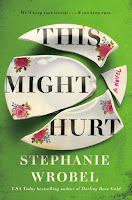
This Might Hurt

This Might Hurt
Title:
  This Might Hurt
Author:  Stephanie Wrobel
Publication Information:  Berkeley. 2022. 336 pages.
ISBN:  0593100085 / 978-0593100080

Book Source:  I received this book through NetGalley and a publisher's blog tour free of cost in exchange for an honest review.

Opening Sentence:  "I stand at the head of the conference table."

Favorite Quote:  "Did we know we were making our favorite memories while they were happening?"

***** BLOG TOUR *****


Review

Wisewood is a place. More than that, Wisewood is a state of mind. "Guests" are expected to come and stay for a minimum of six months. Some come and never leave. During their stay, guests are expected to adhere strictly to the rules. Rules such as no phone, no contact with the outside world, no physical contact with other guests, assigned chores, no leaving, and more. The goal - to help each guest focus entirely on themselves and become fearless.

All Natalie Collins knows is that her sister Kit disappeared into this world about six months ago and has not reappeared. That might have been okay since Natalie and her sister have been estranged. However, Natalie receives an email from someone at Wisewood that they will reveal her secret to Kit. What secret? The email does not say, but Natalie know. So, of course, she takes herself off to Wisewood, find Kit and either prevent the secret from coming out or tell Kit herself before someone else does.

So begins this somewhat confusing story of a cult. There are multiple narrators - Natalie, Kit, and a third unnamed narrator. There are also multiple time periods - the present at Wisewood, Natalie and Kit's childhood, Kit's time as she comes to Wisewood, and an undefined time in the life of the third narrator. Eventually, it all comes together but...

As a reader, it takes me way too long to realize there are three narrators - and not just Natalie and Kit -  and then it takes me way too long to identify who the third narrator is. By the time I realize the connection, it is a little too late to go back, reread and develop a better sense of this character, to redefine the characters who are not this narrator, and bring it all together into what happens next.

This book is dark. The images of child abuse and the physical and psychological scars it leaves are heart wrenching and disturbing. The abuse is relentless. This book does hurt and should absolutely contain trigger warning that is not currently in the book description. The fact that because of the multiple narrators, I realize late in the book the victim of this abuse makes the book a challenge. That unfortunately lessons the understanding of the far-reaching impact that childhood abuse can have.

Beyond the story of the two sisters or really the story of the third narrator, the book is a view into a cult. Perhaps the most fascinating part of this book is the concept on which the cult is based - the idea of facing fears and living live fearlessly. That idea has merit and can likely be found in much of personal development literature and training. To see an idea of merit devolve into a cult with such negative ramifications is relevant to today's world. That view, rather than the characters or the story, is my lasting memory of this book.

About the Author

Stephanie Wrobel grew up in Chicago but lives in the UK for the past three years with her husband and dog, Moose Barkwinkle. She has an MFA from Emerson College and has had short fiction published in Bellevue Literary Review. She is also the author Darling Rose Gold and has been a creative copywriter at various advertising agencies.

About the Book

From the USA Today bestselling and Edgar-nominated author ofDarling Rose Gold comes a dark, thrilling novel about two sisters—one trapped in the clutches of a cult, the other in a web of her own lies.

Welcome to Wisewood. We’ll keep your secrets if you keep ours.

Natalie Collins hasn’t heard from her sister in more than half a year.

The last time they spoke, Kit was slogging from mundane workdays to obligatory happy hours to crying in the shower about their dead mother. She told Natalie she was sure there was something more out there.

And then she found Wisewood.

On a private island off the coast of Maine, Wisewood’s guests commit to six-month stays. During this time, they’re prohibited from contact with the rest of the world—no Internet, no phones, no exceptions. But the rules are for a good reason: to keep guests focused on achieving true fearlessness so they can become their Maximized Selves. Natalie thinks it’s a bad idea, but Kit has had enough of her sister’s cynicism and voluntarily disappears off the grid.

Six months later Natalie receives a menacing e-mail from a Wisewood account threatening to reveal the secret she’s been keeping from Kit. Panicked, Natalie hurries north to come clean to her sister and bring her home. But she’s about to learn that Wisewood won’t let either of them go without a fight.


Please share your thoughts and leave a comment. I would love to "talk" to you.