Sunday, July 24, 2022

The Secret Keeper of Jaipur

Title:
  The Secret Keeper of Jaipur
Author:  Alka Joshi
Publication Information:  MIRA. 2021. 384 pages.
ISBN:  0778331857 / 978-0778331858

Book Source:  I received this book through NetGalley free of cost in exchange for an honest review.

Opening Sentence:  "It's opening night of the Royal Jewel Cinema, which shines as brilliantly as a gemstone."

Favorite Quote:  "We know things about people ... because we go into their homes, the place where they are most vulnerable. That does not mean that we can divulge what we have seen or heard to everyone we know. There's more power in keeping a secret than in betraying it."

The Henna Artist brought us to 1950s India. The British Raj had just ended in 1947. The British Crown ruled the subcontinent from 1858 to 1947. Then came independence and the creation of the countries of India, Pakistan, and eventually Bangladesh. Culturally, the British left their mark on the countries, the government, and particularly on the lifestyles of the rich. The women were often the unspoken matriarchs in what was essentially a male-dominated society. The women wielded power but subtly. So, the idea of a woman make her own way is an even stronger one.

That book introduced sisters Lakshmi and Radha and was definitely more their story than a story of the history of the time. This book moves forward in time and becomes the story of Malik, Lakshmi's protégé. Lakshmi and her husband settled in the hill station of Shimla, but she has arranged for Malik to be an apprentice in the Facilities Office at the Jaipur Palace. Malik leaves behind Lakshmi in Simla but also Nimmi, a young woman he has met. That relationship is just beginning.

While an understanding of the prior book and the characters is helpful to this one, it is not essential. It is possible to enjoy this story on its own as it is more Malik's story than anyone else. Malik was a child in The Henna Artist. In this, he is a grown adult character. He is also the tie between Lakshmi and Nimmi.

The story moves between Simla and Jaipur and shifts between Lakshmi's, Malik's, and Nimmi's perspective. The plot of the book unfolds at different levels. The main project the Facilities Office is working on the opening of a grand cinema. The project completes. However, the book begins, and on opening night, the balcony collapses. Questions abound. How does this happen? Who is responsible? Who will be accountable? How will palace politics play into the outcome?

The palace politics, intrigues, and secrets become a layer of the plot. Who knows who? Who know what about who? Who wields the power? Who thinks they wield the power? It brings Lakshmi back to a world that she leaves far behind when she settles in Simla.

Through it all, of course, is Malik's story. He started as an abandoned street urchin. Lakshmi, while never adopting him formally, became his mother. He is now a young man starting on a career and looking to see where he can take it. At time, he is conflicted between what might be good for his career and what is right. He is also conflicted between where career and growth takes him and what and who he leaves behind.

All of this set in the midst of the beautiful Pink City and the colors, tastes, and sounds of India makes for an engaging story beginning to end. I understand that this is to be a trilogy with the third segment, The Perfumist of Paris bringing us back to Radha's story. The current expected publication date is March, 2023. I can't wait.


Please share your thoughts and leave a comment. I would love to "talk" to you.

Monday, July 18, 2022

The Edge of Summer

The Edge of Summer
Title:
  The Edge of Summer
Author:  Viola Shipman
Publication Information:  Graydon House. 2022. 368 pages.
ISBN:  1525804812 / 978-1525804816

Book Source:  I received this book through NetGalley and the HTP Summer 2022 beach reads blog tour free of cost in exchange for an honest review.

Opening Sentence:  "My mom told everyone dad died, along with my entire family - grandparents, aunts, uncles, and all - one Christmas Day long ago."

Favorite Quote:  "If there's anything I've learned through all of this is that there are many patterns to life. One is cut and created by our parents, who seek not o only to make us in their own image but also to design a better life for us. Another pattern is cut and created by each of us in an attempt to become our own person, unique, different from those before us. And yet another, as I've learned, was cut and created by people we never knew, and we try to live inside of it, even though it no longer fits us. Each pattern fits our bodies at different times in our lives. But it's our hearts, minds and souls that are constantly growing, changing, evolving, shifting, and we rarely consider what patterns works best for them."

***** BLOG TOUR *****


Review

About half way through, the book defines its title. "One moment, I am facing the stunningly beautiful dunes that line the entire coastline, a ring of gold against the water. And then the next moment, I face the horizon, blue on blue, sky meeting lake. I feel as if I'm floating on the edge of infinity. I feel as if I'm floating at the edge of life. The edge of summer."

The description at that point is a literal one as Sutton Douglas swims off a boat in beautiful Michigan. It is also, however, a figurative one taken from the last sentence - edge of life. Sutton Douglas is at a turning point. Raised by a single mother, Sutton is devastated by the death of her mother. Her mother was her sole anchor in life. Her death during the COVID-19 pandemic means that Sutton did not even get to say good bye. However, even in that fierce love, Sutton knows that there were secrets. It was always just her and her mother, with no other family. After her mother's death, Sutton discovers that this may not be so.

Also due to the pandemic, Sutton's job and career has shifted and may not recover. Sutton is a designer, whose clothing is based around buttons - a love she inherits from her mother along with her sewing machine and her collection of buttons. However, the pandemic and the shift in life with people staying home has depleted the demand for what Sutton designs.

At a crossroads, she discovers what might be a connection to her mother's past. This brings Sutton to the small town of Nevermore, Michigan.

Now, the story shifts to that of a small town. Everyone knows everyone. Everyone knows everyone's business. There is a revered town benefactor who might have secrets of her own. Friendships and a romance bloom for Sutton as this small town envelops her in its embrace.

Her journey of self-discovery and discovery of her mother's past continues. The ending is not really a surprise. However, perhaps it's not meant to be as the book is about the journey. For me, the one gap in the story is the actual story of the past. The book explains what happens, but I want to know the why. I want to know why and how the characters from the past make the choices they do and how they end up where they do. That seems perhaps an even more emotional story than Sutton's. It feels as if Sutton's is a sequel to what came before except that it is not.

I suppose that is a testament to the storytelling that I invest in it enough to want to know more. The vivid, idealized descriptions of the Ozarks and the Michigan coastal communities grounds the book and helps bring it to life. I want to know more about the characters, and I want to visit the places described. As always, Wade Rouse, aka Viola Shipman, tells a sweet story of family and place that makes me want to read more.

About the Author

VIOLA SHIPMAN is the pen name for internationally bestselling author Wade Rouse. Wade is the author of fourteen books, which have been translated into 21 languages and sold over a million copies around the world. Wade chose his grandmother’s name, Viola Shipman as a pen name to honor the woman whose heirlooms and family stories inspire his fiction. The last Viola Shipman novel, The Secret of Snow (October 2021), was named a Best Book of Fall by Country Living Magazine and a Best Holiday Book by Good Housekeeping.

Wade hosts the popular Facebook Live literary happy hour, “Wine & Words with Wade,” every Thursday at 6:30 p.m. EST on the Viola Shipman author page where he talks writing, inspiration and welcomes bestselling authors and publishing insiders.

About the Book

Bestselling author Viola Shipman delights with this captivating summertime escape set along the sparkling shores of Lake Michigan, where a woman searches for clues to her secretive mother's past


Devastated by the sudden death of her mother—a quiet, loving and intensely private Southern seamstress called Miss Mabel, who overflowed with pearls of Ozarks wisdom but never spoke of her own family—Sutton Douglas makes the impulsive decision to pack up and head north to the Michigan resort town where she believes she’ll find answers to the lifelong questions she’s had about not only her mother’s past but also her own place in the world.


Recalling Miss Mabel’s sewing notions that were her childhood toys, Sutton buys a collection of buttons at an estate sale from Bonnie Lyons, the imposing matriarch of the lakeside community. Propelled by a handful of trinkets left behind by her mother and glimpses into the history of the magical lakeshore town, Sutton becomes tantalized by the possibility that Bonnie is the grandmother she never knew. But is she? As Sutton cautiously befriends Bonnie and is taken into her confidence, she begins to uncover the secrets about her family that Miss Mabel so carefully hid, and about the role that Sutton herself unwittingly played in it all.

Excerpt

BUTTONHOLE

A small cut in the fabric that is bound with small stitching. The hole has to be just big enough to allow a button to pass through it and remain in place.

My mom told everyone my dad died, along with my entire family—grandparents, aunts, uncles, and all—one Christmas Day long ago.

“Fire,” she’d say. “Woodstove. Took ’em all. Down to the last cousin.”

“How’d you make it out with your little girl?” everyone would always ask, eyes wide, mouths open. “That’s a holiday miracle!”

My mom would start to cry, a tear that grew to a flood, and, well, that would end that.

No one questioned someone who survived such a thing, especially a widowed mother like Miss Mabel, which is what everyone called her out of deference in the Ozarks. Folks down here had lived hard lives, and they buried their kin just like they did their heartache, underneath the rocky earth and red clay. It took too much effort to dig that deep.

That’s why no one ever bothered to check out the story of a simple, hardworking, down-to-earth, churchgoing lady who kept to herself down here in the hollers—despite the fact me and my mom both just appeared out of thin air—in a time before social media existed.

But I did.

Want to know why?

My mom never cried.

She was the least emotional soul I’d ever known.

“How did you make it out with me?” I asked her countless times as I grew older, when it was just the two of us sitting in her sewing room in our tiny cabin tucked amongst the bluffs outside Nevermore, Missouri.

She would never answer immediately, no matter how many times I asked. Instead, she’d turn over one of her button jars or tins, and run her fingers through the buttons as if they were tarot cards that would provide a clue.

I mean, there were no photos, no memories, no footsteps that even led from our fiery escape to the middle of Nevermore. No family wondered where we were? No one cared? My mother made it out with nothing but me? Not a penny to her name? Just some buttons?

We were rich in buttons.

Oh, I had button necklaces in every color growing up— red, green, blue, yellow, white, pink—and I matched them to every outfit I had. We didn’t have money for trendy jewelry or clothes—tennis bracelets, Gloria Vanderbilt jeans—so my mom made nearly everything I wore.

Kids made fun of me at school for that.

“Sutton, the button girl!” they’d taunt me. “Hand-me-downs!”

Wasn’t funny. Ozarks kids weren’t clever. Just annoyingly direct, like the skeeters that constantly buzzed my head.

I loved my necklaces, though. They were like Wonder Woman’s bracelets. For some reason, I always felt protected.

I’d finger and count every button on my necklace waiting for my mom to answer the question I’d asked long ago. She’d just keep searching those buttons, turning them round and round, feeling them, whispering to them, as if they were alive and breathing. The quiet would nearly undo me. A girl should have music and friends’ laughter be the soundtrack of her life, not the clink of buttons and rush of the creek. Most times, I’d spin my button necklace a few times, counting upward of sixty before my mom would answer.

“Alive!” she’d finally say, voice firm, without looking up. “That’s how we made it out…alive. And you should feel darn lucky about that, young lady.”

Then, as if by magic, my mom would always somehow manage to find a matching button to replace a missing one on a hand-me-down blouse of hers, or pluck the “purtiest” ones from the countless buttons in her jar—iridescent abalone or crochet over wound silk f loss—to make the entire blouse seem new again.

Still, she would never smile. In fact, it was as if she had been born old. I had no idea how old she might be: Thirty-five? Fifty? Seventy?

But when she’d find a beautiful button, she would hold it up to study, her gold eyes sparkling in the light from the little lamp over Ol’ Betsy, her Singer sewing machine.

If I watched her long enough, her face would relax just enough to let the deep creases sigh, and the edges of her mouth would curl ever so slightly, as if she had just found the secret to life in her button jar.

“Look at this beautiful button, Sutton,” she’d say. “So many buttons in this jar: fabric, shell, glass, metal, ceramic. All forgotten. All with a story. All from someone and somewhere. People don’t give a whit about buttons anymore, but I do. They hold value, these things that just get tossed aside. Buttons are still the one thing that not only hold a garment together but also make it truly unique.”

Finally, finally, she’d look at me. Right in the eye.

“Lots of beauty and secrets in buttons if you just look long and hard enough.”

The way she said that would make my body explode in goose pimples.

Every night of my childhood, I’d go to bed and stare at my necklace in the moonlight, or I’d play with the buttons in my mom’s jar searching for an answer my mother never provided.

Even today when I design a beautiful dress with pretty, old-fashioned buttons, I think of my mom and how the littlest of things can hold us together.

Or tear us apart.

Buy Links

BookShop.org
Barnes & Noble
Amazon
Books-A-Million
Forever Books
Powell’s

Social Links

Author Website
Twitter: @Viola_Shipman
Facebook: Author Viola Shipman
Instagram: @Viola_Shipman
Goodreads


Please share your thoughts and leave a comment. I would love to "talk" to you.

Friday, July 15, 2022

The Poet's House

The Poet's House
Title:
  The Poet's House
Author:  Jean Thompson
Publication Information:  Algonquin Books. 2022. 320 pages.
ISBN:  1643751565 / 978-1643751566

Book Source:  I received this book through NetGalley and a publisher's blog tour free of cost in exchange for an honest review.

Opening Sentence:  "Before I met Viridian, I didn't know any  poets, any real poets."

Favorite Quote:  "Carla, you need to get over the idea of supposed to be be. You need to develop your own standards, your likes and dislikes. That's part of critical thinking."

***** BLOG TOUR *****


Review

A young woman Carla meets a group of poets and literaries. Carla has a learning disability and has always hovered in the shadow of that:
  • "I didn't want to feel like a problem everybody had to solve. You could get tired of all the encouragement."
  • "I wish I could live my life so that I didn't disappointment anyone."
  • "Because it makes me feel like a special needs child."
She chooses a career - landscaping - that allows her to use her strengths while not relying on what she considers her weakness. This job brings her to the home of poet Viridian. Here, Carla is introduced to a world she felt was always closed to her. "I don't read poems, I can't. I mean, I have a learning disability, I have trouble with reading even basic stuff. But when I heart you read them, it all made sense. It all ended up inside me."

So begins what I would call this coming of age story. Through these poet's, Carla is introduced to her own potential. Those around her do not see the attraction of the poet's house, but Carla is drawn more and more to that world for it opens possibilities she has never imagined for herself.

This story takes a while to settle into. There are many characters surrounding the poets. With the title focused on the poets, that is where I first focus my attention. I find it somewhat challenging to keep the characters and the relationships straight. This was even more so because it went into the poets' past and the past came forward to meet the present.

Eventually, I realized that it is possible just to let that aspect of the story flow. It takes a while to realize that the story is really Carla's. The rest ebbs and flows around her. That's when I settle into the story and follow Carla's journey of growth and self discovery. It's interesting that the character sounds so very young. She is in her twenties, but at times, she sounds considerably younger. The character development really shows the impact of conditioning on confidence and self-esteem.

I appreciate the fact that the book features a main character who is differently abled, and that the growth of the character is about the discovery of the possibilities given the right resources and mentors. In this way, Carla's youthful depiction adds to that discovery. The message of every child and every person being given the path to reach their potential is such an important one.

The fact that art - especially art with words - is the vehicle for Carla's growth of course resonates with this reader. I believe in the power of words to alter lives, and this book personifies that.

About the Book

New York Times bestselling author and former National Book Award finalist Jean Thompson has long been considered one of our most celebrated literary novelists. The author of fourteen works of fiction and the recipient of Guggenheim and National Endowment for the Arts fellowships, Thompson is known for her graceful and beautifully crafted writing, which has been compared to both Alice Munro and Joyce Carol Oates. Algonquin is thrilled to welcome this beloved writer to our list with the publication of The Poet's House, (Algonquin Books; Publication Date: July 12, 2022; $26.95) a witty, delightfully entertaining novel about a young woman who gets swept up in the dramatic, passionate, and often insular world of writers. Both wry and wise, THE POET’S HOUSE is an insightful look at the literary scene – sometimes petty, sometimes transactional, sometimes transformative – and a coming-of-age story about the paths taken to find one’s true passion.

It has been a long, hot summer in Northern California, and Carla, in her early twenties and working as a landscaper, feels unsatisfied and aimless. When she is hired to work at the home of Viridian, an aging poet, both lauded and lovely, Carla is introduced to Viridian’s eccentric group of friends—and most importantly to the beauty and power of poetry—and her life changes drastically. She becomes enamored with Viridian – whose reputation has been defined by her infamous affair with a famous poet, Mathias – and the complicated dynamics of the art world. She develops a new hunger for words, and for life. As a fight emerges over the last cycle of poems Mathias wrote before he died, Carla gets drawn in. Does she even belong in this world? How much will she sacrifice for a group that may or may not see her as one of their own?

“After a lifetime of authorship, I wanted to pay tribute to the enterprise of writing itself, as well as cast an affectionate eye on some of the excesses and bad behavior that can accompany it,” explains Thompson. “With THE POET’S HOUSE, I hope I’ve achieved a balance between the comedy of the human goings-on, and poems themselves, which can inspire and transform us.” Thompson lives outside of Chicago and has instructed creative writing for decades, including the University of Illinois Urbana-Champaign, Reed College, and Northwestern University.

"Jean Thompson is a national treasure,” says Dan Chaon. “She's the kind of writer who can make you laugh and cry at the same time. . . [her] work is full of insight and wisdom and a deadly keen eye for the foibles and self-deceptions of her characters. THE POET'S HOUSE is yet another indelible masterpiece in her oeuvre."

About The Author

Jean Thompson is the author of fourteen books of fiction, including the National Book Award finalist Who Do You Love, the NYT bestseller The Year We Left Home, and the NYT Notable Book Wide Blue Yonder. Her work has been published in the New Yorker, as well as dozens of other magazines, and anthologized in The Best American Short Stories and the Pushcart Prize. She has been the recipient of Guggenheim and National Endowment for the Arts fellowships, among other accolades, and has taught creative writing at numerous colleges around the country.


Please share your thoughts and leave a comment. I would love to "talk" to you.

Wednesday, July 13, 2022

The Son of the House

Title:
  The Son of the House
Author:  Cheluchi Onyemelukwe-Onuobia
Publication Information:  Dundurn. 2021. 304 pages.
ISBN:  1459747089 / 978-1459747081

Book Source:  I received this book through NetGalley free of cost in exchange for an honest review.

Opening Sentence:  "We must do something to pass the time, I thought."

Favorite Quote:  "Forgiveness, I found, was easier on the mind, the soul, the spirit, even the body, than bitterness."

This book begins with a kidnapping of two women in the Nigerian city of Enugu. However, the kidnapping is not the story of this book; it is the vehicle through which the story is told. The two women are captive in a room. To pass the time, they begin to share their life story with each other. One is a story of privilege. The other of poverty. Little do they know that their lives and their stories intersect in a way that neither could imagine.

The title is about a man - the son of the house. The boy accentuates the stress of an Igbo family, the quest for a male heir, and the lengths to which a family will go for a male heir. So often, the fate of a woman is dependent on her ability to give the family an heir. Some men seek out second and third wives in search of an heir. After the birth, the child belongs to the father not the mother.

Despite the title, the story itself is not about the boy or about men. It is about the women. It is the story of girls and then women over the course of four decades living and surviving, and, at times, thriving, in a patriarchy. Nwabulu is orphaned at a young age and goes into service as a housemaid at the age of ten. Disaster after disaster and trouble after trouble seem to follow her. Julie is educated and privileged. She lives alone but is the well kept mistress of a rich man. She has no intention of marrying him, but keeps her status and lifestyle through essentially a lie. Both in their own way are survivors.

The story of strong women surviving is a compelling one. The story of their grief and of their resilience time and again is a compelling one. Through it all, the book is also a window onto Nigerian - particularly Igbo - culture and traditions. As it is not one I know much about, I enjoy the learning. I realize that fiction is not history and that a story is one perspective. Yet, even given that caveat, I enjoy learning that one perspective. As the author's note states, "The idea to write this story came from a true-life story my mother told me about a young child whose path cross mine for a short time during our childhoods ... That story struck me deep in my heart and made me think about how traditions and customs, such as those obtained in the places I explore in my story, can draw us together but also have long-long, life-changing, and resounding impacts. It also made me think about how we all come from the stories that we tell ourselves; of our families, out contexts, our countries and where we came from."

I love the exploration of how traditions define us and how the stories we tell ourselves define us. This book is a compelling and moving debut. I look forward to reading more from the author.


Please share your thoughts and leave a comment. I would love to "talk" to you.

Monday, July 11, 2022

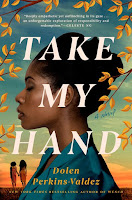
Take My Hand

Take My Hand
Title:
  Take My Hand
Author:  Dolen Perkins-Valdez
Publication Information:  Berkeley. 2022. 368 pages.
ISBN:  0593337697 / 978-0593337691

Book Source:  I received this book through NetGalley and a publisher's blog tour free of cost in exchange for an honest review.

Opening Sentence:  "A year never passes without me thinking of them."

Favorite Quote:  "The past doesn't work that way. You can't just make it disappear. You can't pretend certain things didn't happen."

Montgomery, Alabama, 1973. The history behind this book is the case of the Minnie Lee and Mary Alice Relf, ages 12 and 14. A federally funded clinic in Montgomery, Alabama provided "care" which supposedly included birth control. These girls were poor, black, and mentally incapacitated. The parents were convinced to allow birth control to "protect" the girls from the boys of the neighborhood. Under false pretenses, the illiterate parents provided consent for the medical "care." The girls were sterilized using a tubal ligation. 

Historical statistics show the staggering number of women and minor girls sterilized in this way. A disproportionate number of procedures were on women and girls who were incapacitated in some way; the theory of eugenics and the aim of preventing the genetics of incapacity from passing forward underlied those decisions. The statistics further show the disproportionate number of these procedures performed on women and girls of color. The Relf sister became the face of a lawsuit by the Southern Poverty Law Center agains the US government as these programs were federally funded.

This is the absolutely horrifying history of the United States less than fifty years ago that is the basis of this story. "It is important to note that Take My Hand is not a retelling of these events; instead, I have used the historical record as inspiration to imagine the emotional impact of this moment others like it." (author's note) This book fictionalizes the story through the eyes of a nurse - Civil Townsend. Young and idealistic, Civil joins the Montgomery Family Planning Clinic out of school in the hopes of making a difference in her community. This brings her to the Erica and India, two sisters who are part of her case load.

Civil becomes personally invested in this family and starts asking questions and attempting to improve their lot. What she discovers and what happens next alters her life and their lives forever. Tied into the history of the girls is Civil's own life and her decision at one point in her life to have an abortion - one that was not legally available for it was before Roe v. Wade. Civil's own history becomes wrapped up in the emotion of the reproductive rights of these girls who are too young to even consider reproductive rights at their age.

The book tells this story from Civil's perspective but from two different points - at the time of the events and decades laters as she is retiring from her career not as a nurse but as a physician. This two timeline perspective causes jumps and makes the story at times somewhat challenging. However, that is a minor point to the emotional impact of the story and the history.

What I also appreciate about this book is that it does not end neatly. Life is not neat, and there are often no answers and no resolutions or absolutions to be found. Life goes on, despite sadness, joy, guilt, and all other emotions and despite retribution and justice and despite things that, once done, can never be undone. History must be told and studied and remembered if only to ensure that certain facets of it are never  repeated. An important book and an important conversation as reproductive rights of women are again called into question.

From the author's note... "My hope is that this novel will provoke discussion about culpability in a society that still deems poor, Black, and disabled as categories unfit for motherhood. In a world inundated by information about these tragedies and more, I still passionately believe in the power of the novel (and its readers!) to raise the alarm, influence hearts, and impact lives."


Please share your thoughts and leave a comment. I would love to "talk" to you.

Wednesday, July 6, 2022

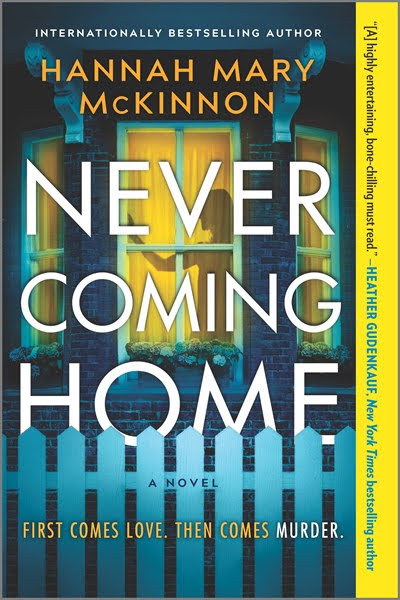
Never Coming Home

Never Coming Home
Title:
  Never Coming Home
Publication Information:  MIRA. 2022. 368 pages.
ISBN:  0778386104 / 978-0778386100

Book Source:  I received this book through NetGalley and a publisher's blog tour free of cost in exchange for an honest review.

Opening Sentence:  "The steady noise from the antique French carriage clock on the mantelpiece had somehow amplified itself, a rhythmic tick-tick, tick-tick, which usually went unnoticed."

Favorite Quote:  "If I were death, I'd be swift, efficient, and merciful, not prescribe a drawn-out, painful process during which body, mind, or both, wasted away. People shouldn't be made to suffer as they died. Not all of them, anyway."

***** BLOG TOUR *****


Review

Is it odd to call a book that begins with a man's plan to kill his wife and take her money a fun read? It might be, but Never Coming Home is really a fun read. First of all, the book is written from the perspective of the presumed villain. This "who done it" is all about the "who" - Lucas Forester.

Lucas Forester is (or was?) married to Michelle. People swooned over their supposedly accidental meeting, their whirlwind romance, and their wedding. They are beautiful people and wealthy and the envy of their friends. The wealthy part, however, is all Michele. Lucas is an invention of his own creation. He also has a plan. His father-in-law is dead.  His mother-in-law is ailing. His brother-in-law is an alcoholic and a drug addict. Only his wife remains in the way of his inheriting everything. So, he puts out a hit on her.

The question is ... is Michelle dead? Did the hitman found through the dark web do his job? It appears to be so as Lucas plays the role of the husband grieving for his "missing" wife and still "hopeful" for her return. He plays this role in front of family, neighbors, friends, and the police. Do they buy it? They appear to.

However, someone knows or someone clearly does not buy Lucas's act. Messages start showing up, and odd things start happening. Lucas is no longer certain if Michelle is actually dead, if the hitman is trying to blackmail him, or if someone else entirely is trying to foil his plan.

So, the book continues with Lucas alternating between panic and the idea that he has it all under control His machinations are interesting as the perspective of the villain is an unusual one in a book such as this. Lucas is a fascinating, well developed character. The visions into his childhood and his evolution from a scared little boy to a debonair, seemingly self-assured man is intriguing. His willingness to kill his wife and his desire to do right by his father are interesting counterpoints. His caring for his rescue dog Roger points and his lack of caring for the humans around him are two sides to him. He is a con man, a thief, a liar, and a murderer. However, despite everything or maybe because of everything, he is fun character to follow. 

The best part is where this book ends up! Of course, that is impossible to say without a spoiler. I will say, I do not see that coming, at least not all the connections. I will also say that when it does, my feeling is that it is the perfect culmination to the story. Perhaps not the very very end which is predictable but hard to envision, but how the story gets there is perfect. And yes, despite its gruesomeness and the sinister idea of killing your wife, the book is an entertaining and fun read.

About the Author

Hannah Mary McKinnon was born in the UK, grew up in Switzerland and moved to Canada in 2010. After a successful career in recruitment, she quit the corporate world in favor of writing, and is now the author of The Neighbors, Her Secret Son, Sister Dear and You Will Remember Me. She lives in Oakville, Ontario, with her husband and three sons, and is delighted by her twenty-second commute.

About the Book

Gone Girl meets Fargo in this deliciously sinister suspense novel about a man who plots his wife's murder to cash in on her inheritance, only to have his brilliant plan turned around on him.

First comes love, then comes murder.

Set to inherit his in-laws’ significant fortune, which would help him care for his ailing father, Lucas Forester decides to help things along by ordering a hit on his wife. (Michelle’s not exactly the most lovable person, anyway.) Everything is going according to his meticulous plan, until he receives a potentially recent photograph of Michelle. Frantic that his plan is being foiled, Lucas must find out if she’s alive, and silence her forever before she can expose him.

Excerpt

Excerpted from Never Coming Home by Hannah Mary McKinnon. Copyright © 2022 by Hannah Mary McKinnon. Published by arrangement with Harlequin Books S.A.
1
SUNDAY

The steady noise from the antique French carriage clock on the mantelpiece had somehow amplified itself, a rhythmic tick-tick, tick-tick, which usually went unnoticed. After I’d been sitting in the same position and holding my ailing mother-in-law’s hand for almost an hour, the incessant clicking had long wormed its way deep into my brain where it grated on my nerves, stirring up fantasies of hammers, bent copper coils, and shattered glass.

Nora looked considerably worse than when I’d visited her earlier this week. She was propped up in bed, surrounded by a multitude of pillows. She’d lost more weight, something her pre-illness slender physique couldn’t afford. Her bones jutted out like rocks on a cliff, turning a kiss on the cheek into an extreme sport in which you might lose an eye. The ghostly hue on her face resembled the kids who’d come dressed up as ghouls for Halloween a few days ago, emphasizing the dark circles that had transformed her eyes into mini sinkholes. It wasn’t clear how much time she had left. I was no medical professional, but we could all tell it wouldn’t be long. When she’d shared her doctor’s diagnosis with me barely three weeks ago, they’d estimated around two months, but at the rate of Nora’s decline, it wouldn’t have come as a surprise if it turned out to be a matter of days.

Ovarian cancer. As a thirty-two-year-old Englishman who wasn’t yet half Nora’s age I’d had no idea it was dubbed the silent killer but now understood why. Despite the considerable wealth and social notoriety Nora enjoyed in the upscale and picturesque town of Chelmswood on the outskirts of Boston, by the time she’d seen someone because of a bad back and they’d worked out what was going on, her vital organs were under siege. The disease was a formidable opponent, the stealthiest of snipers, destroying her from the inside out before she had any indication something was wrong.

A shame, truly, because Nora was the only one in the Ward family I actually liked. I wouldn’t have sat here this long with my arse going numb for my father-in-law’s benefit, that’s for sure. Given half the chance I’d have smothered him with a pillow while the nurse wasn’t looking. But not Nora. She was kindhearted, gentle. The type of person who quietly gave time and money to multiple causes and charities without expecting a single accolade in return. Sometimes I imagined my mother would’ve been like Nora, had she survived, and fleetingly wondered what might have become of me if she hadn’t died so young, if I’d have grown up to be a good person.

I gradually pulled my hand away from Nora’s and reached for my phone, decided on playing a game or two of backgammon until she woke up. The app had thrashed me the last three rounds and I was due, but Nora’s fingers twitched before I made my first move. I studied her brow, which seemed furrowed in pain even as she slept. Not for the first time I hoped the Grim Reaper would stake his or her claim sooner rather than later. If I were death, I’d be swift, efficient, and merciful, not prescribe a drawn-out, painful process during which body, mind, or both, wasted away. People shouldn’t be made to suffer as they died. Not all of them, anyway.

“Lucas?”

I jumped as Diane, Nora’s nurse and my neighbor, put a hand on my shoulder. She’d only left the room for a couple of minutes but always wore those soft-soled shoes when she worked, which meant I never heard her coming until she was next to me. Kind of sneaky, when I thought about it, and I decided I wouldn’t sit with my back to the door again.

As she walked past, the air filled with the distinctive medicinal scent of hand sanitizer and antiseptic. I hated that smell. Too many bad memories I couldn’t shake. Diane set a glass of water on the bedside table, checked Nora’s vitals, and turned around. Hands on hips, she peered down at me from her six-foot frame, her tight dark curls bouncing alongside her jawbone like a set of tiny corkscrews.

“You can go home now. I’ll take the evening from here.” Regardless of her amicable delivery, there was no mistaking the instruction, but she still added, “Get some rest. God knows you look like you need it.”

“Thanks a lot,” I replied with mock indignation. “You sure know how to flatter a guy.”

Diane cocked her head to one side, folded her arms, and gave me another long stare, which to anyone else would’ve been intimidating. “How long since you slept? I mean properly.”

I waved a hand. “It’s only seven o’clock.”

“Yeah, I guess given the circumstances I wouldn’t want to be home alone, either.”

I looked away. “That’s not what this is about. I’ll wait until Nora wakes up again. I want to say goodbye. You know, in case she…” My voice cracked a little on the last word and I feigned a cough as I pressed the heels of my palms over my eyes.

“She won’t,” Diane whispered. “Not tonight. Trust me. She’s not ready to go.”

I knew Diane had worked in hospice for two decades and had seen more than her fair share of people taking their last breaths. If she said Nora wouldn’t die tonight, then Nora would still be here in the morning.

“I’ll leave in a bit. After she wakes up.”

Diane let out a resigned sigh and sat down in the chair on the opposite side of the bed. A comfortable silence settled between us despite the fact we didn’t know each other very well. I’d first met Diane and her wife Karina, who were both in their forties, when they’d struck up a conversation with me and my wife Michelle as we’d moved into our house on the other side of Chelmswood almost three years prior. Something about garbage days and recycling rules, I think. The mundane discussion could’ve led to a multitude of drinks, shared meals, and the swapping of embarrassing childhood stories, except we were all what Michelle had called busy professionals with (quote) hectic work schedules that make forging new friendships difficult. My Captain Subtext translated her comment as can’t be bothered and, consequently, the four of us had never made the transition from neighbors to close friends.

Aside from the occasional holiday party invitation or looking after each other’s places whenever we were away—picking up the mail, watering the plants, that kind of thing—we only saw each other in passing. Nevertheless, Karina regularly left a Welcome Back note on our kitchen counter along with flowers from their garden and a bottle of wine. Not one to be outdone on anything, Michelle reciprocated, except she’d always chosen more elaborate bouquets and fancier booze. My wife’s silent little pissing contests, which I’d pretended to be too dense to notice, had irked me to hell and back, but when Nora fell ill and Diane had been assigned as one of her nurses, I’d been relieved it was someone I knew and trusted.

“I’m sorry this is happening to you,” Diane said, rescuing me from the spousal memories. “It’s not fair. I mean, it’s never fair, obviously, but on top of what you’re going through with Michelle. I can’t imagine. It’s so awful…”

I acknowledged the rest of the words she left hanging in the air with a nod. There was nothing left to say about my wife’s situation we hadn’t already discussed, rediscussed, dissected, reconstructed, and pulled apart all over again. We’d not solved the mystery of her whereabouts or found more clues. Nothing new, helpful or hopeful, anyway. We never would.

Silence descended upon us again, the gaudy carriage clock ticking away, reviving the images of me with hammer in hand until the doorbell masked the sound.

“I’ll go,” Diane muttered, and before I had the chance to stand, she left the room and pulled the door shut. I couldn’t help wondering if her swift departure was because she needed to escape from me, the man who’d used her supportive shoulder almost daily for the past month. I decided to tone it down a little. Nobody wanted to be around an overdramatic, constant crybaby regardless of their circumstances.

I listened for voices but couldn’t hear any despite my leaning toward the door and craning my neck. I couldn’t risk moving in case Nora woke up. Her body was failing, but her mind remained sharp as a box of tacks. She’d wonder what I was up to if she saw my ear pressed against the mahogany panel. Solid mahogany. The best money could buy thanks to the Ward family’s three-generations-old construction empire. No cheap building materials in this house, as my father-in-law had pointed out when he’d first given me the tour of the six bedrooms, four reception rooms, indoor and outdoor kitchens (never mind the abhorrent freezing Boston winters), and what could only be described as grounds because yard implied it was manageable with a push-along mower.

“Only the best for my family,” Gideon had said in his characteristic rumbly, pompous way as he’d knocked back another glass of Laphroaig, the broad East Coast accent he worked hard to hide making more of a reappearance with each gluttonous glug. “No MDF, vinyl or laminate garbage, thank you. That’s not what I’m about. Not at all.”

It’s in the houses you build for others, I’d thought as I’d grunted an inaudible reply he no doubt mistook for agreement because people rarely contradicted him. As I raised my glass of scotch, I didn’t mention the council flats I grew up in on what Gideon dismissed as the lesser side of the pond, or the multiple times Dad and I had been kicked out of our dingy digs because he couldn’t pay the rent, and we’d ended up on the streets. My childhood had been vastly different to my wife’s, and I imagined the pleasure I’d find in watching Gideon’s eyes bulge as I described the squalor I’d lived in, and he realized my background was worlds away from the shiny and elitist version I’d led everyone to believe was the truth. I pictured myself laughing as he understood his perfect daughter had married so far beneath her, she may as well have pulled me up from the dirt like a carrot, and not the expensive organic kind.

Of course, I hadn’t told him anything. I’d taken another swig of the scotch I loathed, but otherwise kept my mouth shut. As satisfying as it would’ve been, my father-in-law knowing the truth about my background had never been part of my long-term agenda. In any case, and despite Gideon’s efforts, things were working to plan. Better than. The smug bastard was dead.

And he wasn’t the only one.

Buy Links

BookShop.org
Harlequin
Barnes & Noble
Amazon
Books-A-MillionPowell’s

Social Links

Author Website
Twitter: @HannahMMcKinnon
Instagram: @hannahmarymckinnon
Facebook: @HannahMaryMcKinnon
Goodreads


Please share your thoughts and leave a comment. I would love to "talk" to you.

Saturday, July 2, 2022

The Lost and Found Girl

The Lost and Found Girl
Title:
  The Lost and Found Girl
Author:  Maisey Yates
Publication Information:  HQN. 2022. 384 pages.
ISBN:  1335427503 / 978-1335427502

Book Source:  I received this book through NetGalley and the HTP Summer 2022  summer reads blog tour free of cost in exchange for an honest review.

Opening Sentence:  "It was five years ago, on a cold December night, when three young girls made a miraculous discovery that changed the town of Pear Blossom forever."

Favorite Quote:  "At some point we have to write our own stories, we have to decide."

***** BLOG TOUR *****


Book Review

Caitlin Groves is the lost girl. She disappeared one night on her way home. She was never found. No one was ever convicted for her disappearance, or worse, her murder. Ruby McKee is the found girl. A year after Caitlin's disappearance, an infant is found by three sisters as they walk home from a church event. No trace is ever found of how she comes to be there or who leaves her there.

Years pass. Nothing much changes in the town of Pear Blossom, Oregon. These two events remain perhaps the biggest events of Pear Blossom's history. Both unresolved.

As the story evolves, it appears that all the girls in the story are lost at some level. Marianne, Lydia, and Dahlia are the three McKee sisters who found Ruby. Ruby was adopted by the family and became the fourth McKee sister. Now, as adults, it appears that they are all lost in their own ways.

Marianne is happily married, or so she thinks. Perhaps, not all is as joyful or harmonious as it seems. Lydia's husband - her childhood sweetheart - died recently of ALS. She appears drowning in grief, but the question is what is that grief really about and what happens when people find out the reason. Dahlia feels herself always not quite good enough. She finds her passion in telling other people's story. However, is she creating her own story? Ruby is the only one who left Pear Blossom, but now she is back - to support her sister and to take a new job. Ruby was Pear Blossom's "miracle", but what - miracle, tragedy, and darkness - lies beyond the perceived miracle of Ruby.

The story weaves through the perspectives of the four sisters and their own version of being lost. The recurring theme is to not be defined by your circumstances, by what happens to you, or by what other people see you as. "At some point we have to write our own stories, we have to decide." I love the theme of the book. The idea of creating our own identity and our own story is a powerful one.

The fact that the book entwines that the mystery of what happened to Caitlin and how Ruby came to be adds depth and drama to this family story. The book further adds to this story of women although these are not instant, love-at-first-sight romances but rather romance in a marriage, romance in a friendship, and romance where the broken pieces of one person recognize another. These are relationships - messy and complicated - more so than romances. That adds depth to this story. Running throughout, of course, are the bonds of sisterhood.

Then comes the ending and my only concern with the book. The ending is not one that could have been predicted. The ending also takes this book about messy, complicated emotions and relationships and ties it up in a package with all the loose ends tied and a vision of happily ever after to come. With that, the book loses a little bit of its impact. Life is unfortunately not that neatly packaged, no matter how much we wish for it to be some days. It just isn't. Certainty and resolutions are not always found. I wish the book had left some things unresolved. An enjoyable summer read nevertheless. 

About the Author  

Maisey Yates is a New York Times bestselling author of over one hundred romance novels. Whether she's writing strong, hard working cowboys, dissolute princes or multigenerational family stories, she loves getting lost in fictional worlds. An avid knitter with a dangerous yarn addiction and an aversion to housework, Maisey lives with her husband and three kids in rural Oregon. Check out her website, maiseyyates.com or find her on Facebook.

About the Book

The small Oregon town of Pear Blossom welcomes the return of its prodigal daughter Ruby McKee. Found abandoned as a baby by the McKee family, Ruby is the unofficial town mascot, but when she and her adoptive sisters start investigating the true circumstances around her discovery, it soon becomes clear that this small town is hiding the biggest, and darkest, of secrets. A raw, powerful exploration of the lengths people go to protect their loved ones, for fans of Lori Wilde and Carolyn Brown.

Ruby McKee is a miracle.

It’s a miracle she survived, abandoned as a newborn baby. A miracle that she was found by the McKee sisters. Her discovery allowed the community of Pear Blossom, Oregon, broken by a devastating crime, to heal. Since then, Ruby has lived a charmed life. But she can’t let go of the need to know why she was abandoned, and she’s tired of not having answers.

Dahlia McKee knows it’s not right to resent Ruby for being special. But uncovering the truth about sister Ruby’s origins could allow Dahlia to carve her own place in Pear Blossom history… if she’s brave enough to follow her heart.

Widowed sister Lydia McKee doesn’t have time for Ruby’s what if’s – when Lydia’s right now is so, so hard. Her husband’s best friend Chase might be offering to share some of the load, but can Lydia ever trust her instincts around him?

Marianne Martin is glad that her youngest sister is back in town, but balancing Ruby’s crusade with the way her own life is imploding is turning into a bigger chore than she imagined. Especially when Ruby starts overturning secrets about the past that Marianne has spent a lifetime trying to pretend don’t exist.

And when the truth about Ruby’s miraculous origins, and the crime from long ago, turn out to be connected in ways no one could have expected, will the McKee sisters band together, or fall apart?

Excerpt

Excerpted from The Lost and Found Girl by Maisey Yates. Copyright © 2022 by Maisey Yates. Published by arrangement with Harlequin Books S.A.

One
Ruby

Only two truly remarkable things had ever happened in the small town of Pear Blossom, Oregon. The first occurred in 1999, when Caitlin Groves disappeared one fall evening on her way home from her boyfriend’s family orchard.

The second was in 2000, when newborn Ruby McKee was discovered on Sentinel Bridge, the day before Christmas Eve.

It wasn’t as if Pear Blossom hadn’t had excitement before then. There was the introduction of pear orchards—an event which ultimately determined the town’s name—in the late 1800s. Outlaws who lay in wait to rob the mail coaches, and wolves and mountain lions who made meals of the farmers’ animals. The introduction of the railroad, electricity and a particularly active society of suffragettes, when women were lobbying for the right to vote.

But all of that blended into the broader context of history, not entirely dissimilar to the goings-on of every town in every part of the world, as men fought to tame a wild land and the land rose up and fought back.

Caitlin’s disappearance and Ruby’s appearance felt both specific and personal, and had scarred and healed—if Ruby took the proclamations of various citizens too literally, which she really tried not to do—the community.

Mostly, as Ruby got out of the car she’d hired at the airport and stood in front of Sentinel Bridge with a suitcase in one hand, she marveled at how idyllic and the same it all seemed.

The bridge itself was battered from the years. The wood dark and marred, but sturdy as ever. A white circle with a white 1917, denoting the year of its construction, was stenciled in the top center of the bridge, just above the tunnel that led to the other side, a pinhole of light visible in the darkness across the way.

It was only open to foot traffic now, with a road curving wide around it and carrying cars to the other side a different way. For years, Sentinel Bridge was closed, and it wasn’t until a community outreach and education effort in the mid nineties that it was reopened for people to walk on.

Ruby could have had the driver take her a different route.

But she wanted to cross the bridge.

“Are you sure you want me to leave you here?” her driver asked.

She’d told him when she’d gotten into his car that she was from here originally, and he’d still spent the drive explaining local landmarks to her, so she wasn’t all that surprised he didn’t trust her directive to leave her in the middle of nowhere.

He was the kind of man who just knew best.

They’d just driven through the town proper. All brick—red and white and yellow—the sidewalks lined with trees whose leaves matched as early fall took hold. It was early, and the town had still been sleepy, most of the shops closed. There had been a runner or two out, an older man—Tom Swenson—walking his dog. But otherwise it had been empty. Still, it bore more marks of civilization than where they stood now.

The bridge was nearly engulfed in trees, some of which were evergreen, others beginning to show rusted hints of autumn around the edges. A golden shaft of light cut over the treetops, bathing the front of the bridge in a warm glow, illuminating the long wooden walk—where the road ended—that led to the covered portion, but shrouding the entrance in darkness.

She could see what the man in the car saw. Something abandoned and eerie and disquieting.

But Ruby only saw the road home.

“It’s fine,” she said.

She did not explain that her parents’ farm was just up the road, and she walked this way all the time.

That it was only a quarter of a mile from where she’d been found as a baby.

She had to cross the bridge nearly every day when she was in town, so she didn’t always think of it. But some days, days like this after she’d been away awhile, she had a strange, hushed feeling in her heart, like she was about to pay homage at a grave.

“If you’re sure.” His tone clearly said she shouldn’t be, but he still took her easy wave as his invitation to go.

Ruby turned away from the retreating car and smiled, wrapping both hands around the handle of her battered brown suitcase. It wasn’t weathered from her own use. She’d picked it up at a charity shop in York, England, because she’d thought it had a good aesthetic and it was just small enough to be a carry-on, but wasn’t like one of those black wheeled things that everyone else had.

She’d cursed while she’d lugged it through Heathrow and Newark and Denver, then finally Medford. Those wheely bags that were not unique at all had seemed more attractive each time her shoulders and arms throbbed from carrying the very lovely suitcase.

Ruby’s love of history was oftentimes not practical.

But it didn’t matter now. The ache in her arms had faded and she was nearly home.

Her parents would have come to pick her up from the airport but Ruby had swapped her flight in Denver to an earlier one so she didn’t have to hang around for half the day. It had just meant getting up and rushing out of the airport adjacent hotel she’d stayed in for only a couple of hours. Her Newark flight had gotten in at eleven thirty the night before and by the time she’d collected her bags, gotten to the hotel and stumbled into bed, it had been nearly one in the morning.

Then she’d been up again at three for the five o’clock flight into Medford, which had set her back on the ground around the time she’d taken off. Which had made her feel gritty and exhausted and wholly uncertain of the time. She’d passed through so many time zones nothing felt real.

She waved the driver off and took the first step forward. She paused at the entry to the bridge. She looked back over her shoulder at the bright sunshine around her and then took a step forward into the darkness. Light came up through the cracks between the wood on the ground and the walls. At the center of the bridge, there were two windows with no glass that looked out over the river below. It was by those windows that she’d been found.

She walked briskly through the bridge and then stopped. In spite of herself. She often walked on this bridge and never felt a thing. She rarely felt inclined to ponder the night that she was found. If she got ridiculous about that too often, then she would never get anything done. After all, she had to cross this bridge to get home.

But she was moving back to town, not just returning for a visit, and it felt right to mark the occasion with a stop at the place of her salvation. She paused for a moment, right at the spot between the two openings that looked out on the water.

She had been placed just there. Down on the ground. Wrapped in a blanket, but still so desperately tiny and alone.

She had always thought about the moment when her sisters had picked her up and brought her back to their parents. It was the moment that came before that she had a hard time with. The one where someone—it had to have been her birth mother—had set her down there, leaving her to fate. To die if she died, or live if she was found. And thankfully she’d been found, but there had been no way for the person who had set her there to know that would happen.

It had gotten below freezing that night.

If Marianne, Lydia and Dahlia hadn’t come walking through from the Christmas play rehearsal, then…

She didn’t cry. But a strange sort of hollowness spread out in her chest.

But she ignored it and decided to press on toward home. She walked through the darkness of the bridge, watching as the light, the exit loomed larger.

And once she was outside, she could breathe. Because it didn’t matter what had happened there. What mattered was every step she had taken thereafter. What mattered was this road back home.

She walked up the gravel-covered road, kicking rocks out of her way as she went. It was delightfully cold, the crisp morning a reminder of exactly why she loved Pear Blossom. It was completely silent out here except for the odd braying of a donkey and chirping birds. She looked down at the view below, at the way the mist hung over the pear trees in the orchard. The way it created a ring around the mountain, the proud peak standing out above it. A blanket of green and gold, rimmed with misty rose.

She breathed in deep and kept on walking, relishing the silence, relishing the sense of home.

She had spent the last four years studying history. Mostly abroad. She had engaged in every exchange program she could, because what was the point of studying history if you limited yourself to a country that was as young as the United States and to a coast as new as the West Coast.

She could remember the awe that she’d experienced walking on streets that were more than just a couple of hundred years old. The immense breadth of time that she had felt. And she had… Well, she had hoped that she would find answers somewhere. Because she had always believed that the answers to what ails you in the present could be found somewhere in the past.

And she’d explored the past. Thoroughly. Many different facets of it. And along the way, she done a bit of exploring of herself.

After all, that was half the reason she’d left. To try and figure out who she was outside of this place where everyone knew her, and her story.

Though, when she got close to people, it didn’t take long for them to discover her story. It was, after all, in the news.

Of course, she always found it interesting who discovered it on their own. Because that was revealing.

Who googled their friends.

Ruby obviously googled her friends, but that was because of her own background and experience. If those same friends had an equally salacious background, then it was forgivable.

But if they were boring, then she found it deeply suspicious that they engaged in such activities.

She came over a slight rise in the road and before her was the McKee family farm. It had been in the McKee family for generations. And Ruby felt a profound sense of connection to it. It might not be her legacy by blood, but that had never mattered to the McKees, and it didn’t matter to her either. This town was part of who she was.

And maybe that was why no matter how she had searched elsewhere, she was drawn back here.

Dana Groves, her old mentor, had called her six months ago to tell her an archivist position was being created in the historical society with some newly allocated funds, and had offered the job to Ruby.

Ruby loved Pear Blossom, but she’d also felt like it was really important for her to go out in the world and see what else existed.

It was easy for her to be in Pear Blossom. People here loved her.

It had been a fascinating experience to go to a place where that wasn’t automatically the case. Of course, she hadn’t stayed in one place very long. After going to the University of Washington, she had gotten involved in different study abroad programs, and she had moved between them as often as she could. Studying in Italy, France, Spain, coming to the States briefly for her graduation ceremony in May, and then going back overseas to spend a few months in England, finishing up some elective study programs.

But then, she’d found that instructive too. Being in a constant state of meeting new people. And for a while, the sheer differentness of it all had fed her in a way that had quieted that restlessness. She had been learning. Learning and experiencing and… Well, part of her had wondered if her first job needed to be away from home. To continue her education.

But then six months ago her sister’s husband had died.

And Dana’s offer of a job in Pear Blossom after she finished her degree had suddenly seemed like fate. Because Ruby had to come and try to make things better for Lydia.

Marianne and Dahlia were worried about Lydia, who had retreated into herself and had barely shed a single tear.

She’s acting just like our parents. No fuss, no muss. No crying over spilled milk or dead husbands.

Clearly miserable, in other words.

And Ruby knew she was needed.

One thing about being saved, about being spared from death, was the certainty you were spared for a reason.

Ruby had been saved by her sisters. And if they ever needed her…

Well, she would be here.
Please share your thoughts and leave a comment. I would love to "talk" to you.