Wednesday, July 13, 2022

The Son of the House

Title:
  The Son of the House
Author:  Cheluchi Onyemelukwe-Onuobia
Publication Information:  Dundurn. 2021. 304 pages.
ISBN:  1459747089 / 978-1459747081

Book Source:  I received this book through NetGalley free of cost in exchange for an honest review.

Opening Sentence:  "We must do something to pass the time, I thought."

Favorite Quote:  "Forgiveness, I found, was easier on the mind, the soul, the spirit, even the body, than bitterness."

This book begins with a kidnapping of two women in the Nigerian city of Enugu. However, the kidnapping is not the story of this book; it is the vehicle through which the story is told. The two women are captive in a room. To pass the time, they begin to share their life story with each other. One is a story of privilege. The other of poverty. Little do they know that their lives and their stories intersect in a way that neither could imagine.

The title is about a man - the son of the house. The boy accentuates the stress of an Igbo family, the quest for a male heir, and the lengths to which a family will go for a male heir. So often, the fate of a woman is dependent on her ability to give the family an heir. Some men seek out second and third wives in search of an heir. After the birth, the child belongs to the father not the mother.

Despite the title, the story itself is not about the boy or about men. It is about the women. It is the story of girls and then women over the course of four decades living and surviving, and, at times, thriving, in a patriarchy. Nwabulu is orphaned at a young age and goes into service as a housemaid at the age of ten. Disaster after disaster and trouble after trouble seem to follow her. Julie is educated and privileged. She lives alone but is the well kept mistress of a rich man. She has no intention of marrying him, but keeps her status and lifestyle through essentially a lie. Both in their own way are survivors.

The story of strong women surviving is a compelling one. The story of their grief and of their resilience time and again is a compelling one. Through it all, the book is also a window onto Nigerian - particularly Igbo - culture and traditions. As it is not one I know much about, I enjoy the learning. I realize that fiction is not history and that a story is one perspective. Yet, even given that caveat, I enjoy learning that one perspective. As the author's note states, "The idea to write this story came from a true-life story my mother told me about a young child whose path cross mine for a short time during our childhoods ... That story struck me deep in my heart and made me think about how traditions and customs, such as those obtained in the places I explore in my story, can draw us together but also have long-long, life-changing, and resounding impacts. It also made me think about how we all come from the stories that we tell ourselves; of our families, out contexts, our countries and where we came from."

I love the exploration of how traditions define us and how the stories we tell ourselves define us. This book is a compelling and moving debut. I look forward to reading more from the author.


Please share your thoughts and leave a comment. I would love to "talk" to you.

Monday, July 11, 2022

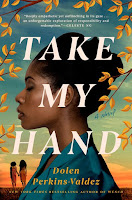
Take My Hand

Take My Hand
Title:
  Take My Hand
Author:  Dolen Perkins-Valdez
Publication Information:  Berkeley. 2022. 368 pages.
ISBN:  0593337697 / 978-0593337691

Book Source:  I received this book through NetGalley and a publisher's blog tour free of cost in exchange for an honest review.

Opening Sentence:  "A year never passes without me thinking of them."

Favorite Quote:  "The past doesn't work that way. You can't just make it disappear. You can't pretend certain things didn't happen."

Montgomery, Alabama, 1973. The history behind this book is the case of the Minnie Lee and Mary Alice Relf, ages 12 and 14. A federally funded clinic in Montgomery, Alabama provided "care" which supposedly included birth control. These girls were poor, black, and mentally incapacitated. The parents were convinced to allow birth control to "protect" the girls from the boys of the neighborhood. Under false pretenses, the illiterate parents provided consent for the medical "care." The girls were sterilized using a tubal ligation. 

Historical statistics show the staggering number of women and minor girls sterilized in this way. A disproportionate number of procedures were on women and girls who were incapacitated in some way; the theory of eugenics and the aim of preventing the genetics of incapacity from passing forward underlied those decisions. The statistics further show the disproportionate number of these procedures performed on women and girls of color. The Relf sister became the face of a lawsuit by the Southern Poverty Law Center agains the US government as these programs were federally funded.

This is the absolutely horrifying history of the United States less than fifty years ago that is the basis of this story. "It is important to note that Take My Hand is not a retelling of these events; instead, I have used the historical record as inspiration to imagine the emotional impact of this moment others like it." (author's note) This book fictionalizes the story through the eyes of a nurse - Civil Townsend. Young and idealistic, Civil joins the Montgomery Family Planning Clinic out of school in the hopes of making a difference in her community. This brings her to the Erica and India, two sisters who are part of her case load.

Civil becomes personally invested in this family and starts asking questions and attempting to improve their lot. What she discovers and what happens next alters her life and their lives forever. Tied into the history of the girls is Civil's own life and her decision at one point in her life to have an abortion - one that was not legally available for it was before Roe v. Wade. Civil's own history becomes wrapped up in the emotion of the reproductive rights of these girls who are too young to even consider reproductive rights at their age.

The book tells this story from Civil's perspective but from two different points - at the time of the events and decades laters as she is retiring from her career not as a nurse but as a physician. This two timeline perspective causes jumps and makes the story at times somewhat challenging. However, that is a minor point to the emotional impact of the story and the history.

What I also appreciate about this book is that it does not end neatly. Life is not neat, and there are often no answers and no resolutions or absolutions to be found. Life goes on, despite sadness, joy, guilt, and all other emotions and despite retribution and justice and despite things that, once done, can never be undone. History must be told and studied and remembered if only to ensure that certain facets of it are never  repeated. An important book and an important conversation as reproductive rights of women are again called into question.

From the author's note... "My hope is that this novel will provoke discussion about culpability in a society that still deems poor, Black, and disabled as categories unfit for motherhood. In a world inundated by information about these tragedies and more, I still passionately believe in the power of the novel (and its readers!) to raise the alarm, influence hearts, and impact lives."


Please share your thoughts and leave a comment. I would love to "talk" to you.

Wednesday, July 6, 2022

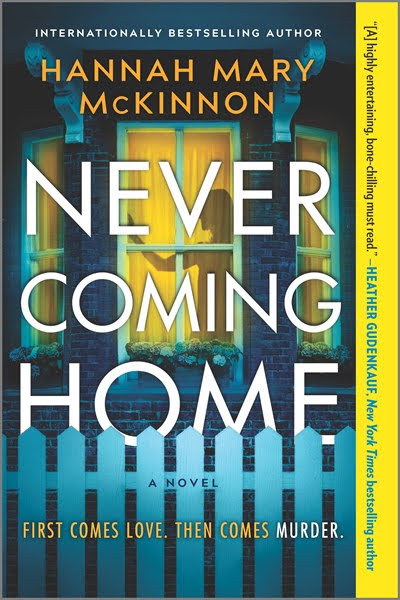
Never Coming Home

Never Coming Home
Title:
  Never Coming Home
Publication Information:  MIRA. 2022. 368 pages.
ISBN:  0778386104 / 978-0778386100

Book Source:  I received this book through NetGalley and a publisher's blog tour free of cost in exchange for an honest review.

Opening Sentence:  "The steady noise from the antique French carriage clock on the mantelpiece had somehow amplified itself, a rhythmic tick-tick, tick-tick, which usually went unnoticed."

Favorite Quote:  "If I were death, I'd be swift, efficient, and merciful, not prescribe a drawn-out, painful process during which body, mind, or both, wasted away. People shouldn't be made to suffer as they died. Not all of them, anyway."

***** BLOG TOUR *****


Review

Is it odd to call a book that begins with a man's plan to kill his wife and take her money a fun read? It might be, but Never Coming Home is really a fun read. First of all, the book is written from the perspective of the presumed villain. This "who done it" is all about the "who" - Lucas Forester.

Lucas Forester is (or was?) married to Michelle. People swooned over their supposedly accidental meeting, their whirlwind romance, and their wedding. They are beautiful people and wealthy and the envy of their friends. The wealthy part, however, is all Michele. Lucas is an invention of his own creation. He also has a plan. His father-in-law is dead.  His mother-in-law is ailing. His brother-in-law is an alcoholic and a drug addict. Only his wife remains in the way of his inheriting everything. So, he puts out a hit on her.

The question is ... is Michelle dead? Did the hitman found through the dark web do his job? It appears to be so as Lucas plays the role of the husband grieving for his "missing" wife and still "hopeful" for her return. He plays this role in front of family, neighbors, friends, and the police. Do they buy it? They appear to.

However, someone knows or someone clearly does not buy Lucas's act. Messages start showing up, and odd things start happening. Lucas is no longer certain if Michelle is actually dead, if the hitman is trying to blackmail him, or if someone else entirely is trying to foil his plan.

So, the book continues with Lucas alternating between panic and the idea that he has it all under control His machinations are interesting as the perspective of the villain is an unusual one in a book such as this. Lucas is a fascinating, well developed character. The visions into his childhood and his evolution from a scared little boy to a debonair, seemingly self-assured man is intriguing. His willingness to kill his wife and his desire to do right by his father are interesting counterpoints. His caring for his rescue dog Roger points and his lack of caring for the humans around him are two sides to him. He is a con man, a thief, a liar, and a murderer. However, despite everything or maybe because of everything, he is fun character to follow. 

The best part is where this book ends up! Of course, that is impossible to say without a spoiler. I will say, I do not see that coming, at least not all the connections. I will also say that when it does, my feeling is that it is the perfect culmination to the story. Perhaps not the very very end which is predictable but hard to envision, but how the story gets there is perfect. And yes, despite its gruesomeness and the sinister idea of killing your wife, the book is an entertaining and fun read.

About the Author

Hannah Mary McKinnon was born in the UK, grew up in Switzerland and moved to Canada in 2010. After a successful career in recruitment, she quit the corporate world in favor of writing, and is now the author of The Neighbors, Her Secret Son, Sister Dear and You Will Remember Me. She lives in Oakville, Ontario, with her husband and three sons, and is delighted by her twenty-second commute.

About the Book

Gone Girl meets Fargo in this deliciously sinister suspense novel about a man who plots his wife's murder to cash in on her inheritance, only to have his brilliant plan turned around on him.

First comes love, then comes murder.

Set to inherit his in-laws’ significant fortune, which would help him care for his ailing father, Lucas Forester decides to help things along by ordering a hit on his wife. (Michelle’s not exactly the most lovable person, anyway.) Everything is going according to his meticulous plan, until he receives a potentially recent photograph of Michelle. Frantic that his plan is being foiled, Lucas must find out if she’s alive, and silence her forever before she can expose him.

Excerpt

Excerpted from Never Coming Home by Hannah Mary McKinnon. Copyright © 2022 by Hannah Mary McKinnon. Published by arrangement with Harlequin Books S.A.
1
SUNDAY

The steady noise from the antique French carriage clock on the mantelpiece had somehow amplified itself, a rhythmic tick-tick, tick-tick, which usually went unnoticed. After I’d been sitting in the same position and holding my ailing mother-in-law’s hand for almost an hour, the incessant clicking had long wormed its way deep into my brain where it grated on my nerves, stirring up fantasies of hammers, bent copper coils, and shattered glass.

Nora looked considerably worse than when I’d visited her earlier this week. She was propped up in bed, surrounded by a multitude of pillows. She’d lost more weight, something her pre-illness slender physique couldn’t afford. Her bones jutted out like rocks on a cliff, turning a kiss on the cheek into an extreme sport in which you might lose an eye. The ghostly hue on her face resembled the kids who’d come dressed up as ghouls for Halloween a few days ago, emphasizing the dark circles that had transformed her eyes into mini sinkholes. It wasn’t clear how much time she had left. I was no medical professional, but we could all tell it wouldn’t be long. When she’d shared her doctor’s diagnosis with me barely three weeks ago, they’d estimated around two months, but at the rate of Nora’s decline, it wouldn’t have come as a surprise if it turned out to be a matter of days.

Ovarian cancer. As a thirty-two-year-old Englishman who wasn’t yet half Nora’s age I’d had no idea it was dubbed the silent killer but now understood why. Despite the considerable wealth and social notoriety Nora enjoyed in the upscale and picturesque town of Chelmswood on the outskirts of Boston, by the time she’d seen someone because of a bad back and they’d worked out what was going on, her vital organs were under siege. The disease was a formidable opponent, the stealthiest of snipers, destroying her from the inside out before she had any indication something was wrong.

A shame, truly, because Nora was the only one in the Ward family I actually liked. I wouldn’t have sat here this long with my arse going numb for my father-in-law’s benefit, that’s for sure. Given half the chance I’d have smothered him with a pillow while the nurse wasn’t looking. But not Nora. She was kindhearted, gentle. The type of person who quietly gave time and money to multiple causes and charities without expecting a single accolade in return. Sometimes I imagined my mother would’ve been like Nora, had she survived, and fleetingly wondered what might have become of me if she hadn’t died so young, if I’d have grown up to be a good person.

I gradually pulled my hand away from Nora’s and reached for my phone, decided on playing a game or two of backgammon until she woke up. The app had thrashed me the last three rounds and I was due, but Nora’s fingers twitched before I made my first move. I studied her brow, which seemed furrowed in pain even as she slept. Not for the first time I hoped the Grim Reaper would stake his or her claim sooner rather than later. If I were death, I’d be swift, efficient, and merciful, not prescribe a drawn-out, painful process during which body, mind, or both, wasted away. People shouldn’t be made to suffer as they died. Not all of them, anyway.

“Lucas?”

I jumped as Diane, Nora’s nurse and my neighbor, put a hand on my shoulder. She’d only left the room for a couple of minutes but always wore those soft-soled shoes when she worked, which meant I never heard her coming until she was next to me. Kind of sneaky, when I thought about it, and I decided I wouldn’t sit with my back to the door again.

As she walked past, the air filled with the distinctive medicinal scent of hand sanitizer and antiseptic. I hated that smell. Too many bad memories I couldn’t shake. Diane set a glass of water on the bedside table, checked Nora’s vitals, and turned around. Hands on hips, she peered down at me from her six-foot frame, her tight dark curls bouncing alongside her jawbone like a set of tiny corkscrews.

“You can go home now. I’ll take the evening from here.” Regardless of her amicable delivery, there was no mistaking the instruction, but she still added, “Get some rest. God knows you look like you need it.”

“Thanks a lot,” I replied with mock indignation. “You sure know how to flatter a guy.”

Diane cocked her head to one side, folded her arms, and gave me another long stare, which to anyone else would’ve been intimidating. “How long since you slept? I mean properly.”

I waved a hand. “It’s only seven o’clock.”

“Yeah, I guess given the circumstances I wouldn’t want to be home alone, either.”

I looked away. “That’s not what this is about. I’ll wait until Nora wakes up again. I want to say goodbye. You know, in case she…” My voice cracked a little on the last word and I feigned a cough as I pressed the heels of my palms over my eyes.

“She won’t,” Diane whispered. “Not tonight. Trust me. She’s not ready to go.”

I knew Diane had worked in hospice for two decades and had seen more than her fair share of people taking their last breaths. If she said Nora wouldn’t die tonight, then Nora would still be here in the morning.

“I’ll leave in a bit. After she wakes up.”

Diane let out a resigned sigh and sat down in the chair on the opposite side of the bed. A comfortable silence settled between us despite the fact we didn’t know each other very well. I’d first met Diane and her wife Karina, who were both in their forties, when they’d struck up a conversation with me and my wife Michelle as we’d moved into our house on the other side of Chelmswood almost three years prior. Something about garbage days and recycling rules, I think. The mundane discussion could’ve led to a multitude of drinks, shared meals, and the swapping of embarrassing childhood stories, except we were all what Michelle had called busy professionals with (quote) hectic work schedules that make forging new friendships difficult. My Captain Subtext translated her comment as can’t be bothered and, consequently, the four of us had never made the transition from neighbors to close friends.

Aside from the occasional holiday party invitation or looking after each other’s places whenever we were away—picking up the mail, watering the plants, that kind of thing—we only saw each other in passing. Nevertheless, Karina regularly left a Welcome Back note on our kitchen counter along with flowers from their garden and a bottle of wine. Not one to be outdone on anything, Michelle reciprocated, except she’d always chosen more elaborate bouquets and fancier booze. My wife’s silent little pissing contests, which I’d pretended to be too dense to notice, had irked me to hell and back, but when Nora fell ill and Diane had been assigned as one of her nurses, I’d been relieved it was someone I knew and trusted.

“I’m sorry this is happening to you,” Diane said, rescuing me from the spousal memories. “It’s not fair. I mean, it’s never fair, obviously, but on top of what you’re going through with Michelle. I can’t imagine. It’s so awful…”

I acknowledged the rest of the words she left hanging in the air with a nod. There was nothing left to say about my wife’s situation we hadn’t already discussed, rediscussed, dissected, reconstructed, and pulled apart all over again. We’d not solved the mystery of her whereabouts or found more clues. Nothing new, helpful or hopeful, anyway. We never would.

Silence descended upon us again, the gaudy carriage clock ticking away, reviving the images of me with hammer in hand until the doorbell masked the sound.

“I’ll go,” Diane muttered, and before I had the chance to stand, she left the room and pulled the door shut. I couldn’t help wondering if her swift departure was because she needed to escape from me, the man who’d used her supportive shoulder almost daily for the past month. I decided to tone it down a little. Nobody wanted to be around an overdramatic, constant crybaby regardless of their circumstances.

I listened for voices but couldn’t hear any despite my leaning toward the door and craning my neck. I couldn’t risk moving in case Nora woke up. Her body was failing, but her mind remained sharp as a box of tacks. She’d wonder what I was up to if she saw my ear pressed against the mahogany panel. Solid mahogany. The best money could buy thanks to the Ward family’s three-generations-old construction empire. No cheap building materials in this house, as my father-in-law had pointed out when he’d first given me the tour of the six bedrooms, four reception rooms, indoor and outdoor kitchens (never mind the abhorrent freezing Boston winters), and what could only be described as grounds because yard implied it was manageable with a push-along mower.

“Only the best for my family,” Gideon had said in his characteristic rumbly, pompous way as he’d knocked back another glass of Laphroaig, the broad East Coast accent he worked hard to hide making more of a reappearance with each gluttonous glug. “No MDF, vinyl or laminate garbage, thank you. That’s not what I’m about. Not at all.”

It’s in the houses you build for others, I’d thought as I’d grunted an inaudible reply he no doubt mistook for agreement because people rarely contradicted him. As I raised my glass of scotch, I didn’t mention the council flats I grew up in on what Gideon dismissed as the lesser side of the pond, or the multiple times Dad and I had been kicked out of our dingy digs because he couldn’t pay the rent, and we’d ended up on the streets. My childhood had been vastly different to my wife’s, and I imagined the pleasure I’d find in watching Gideon’s eyes bulge as I described the squalor I’d lived in, and he realized my background was worlds away from the shiny and elitist version I’d led everyone to believe was the truth. I pictured myself laughing as he understood his perfect daughter had married so far beneath her, she may as well have pulled me up from the dirt like a carrot, and not the expensive organic kind.

Of course, I hadn’t told him anything. I’d taken another swig of the scotch I loathed, but otherwise kept my mouth shut. As satisfying as it would’ve been, my father-in-law knowing the truth about my background had never been part of my long-term agenda. In any case, and despite Gideon’s efforts, things were working to plan. Better than. The smug bastard was dead.

And he wasn’t the only one.

Buy Links

BookShop.org
Harlequin
Barnes & Noble
Amazon
Books-A-MillionPowell’s

Social Links

Author Website
Twitter: @HannahMMcKinnon
Instagram: @hannahmarymckinnon
Facebook: @HannahMaryMcKinnon
Goodreads


Please share your thoughts and leave a comment. I would love to "talk" to you.

Saturday, July 2, 2022

The Lost and Found Girl

The Lost and Found Girl
Title:
  The Lost and Found Girl
Author:  Maisey Yates
Publication Information:  HQN. 2022. 384 pages.
ISBN:  1335427503 / 978-1335427502

Book Source:  I received this book through NetGalley and the HTP Summer 2022  summer reads blog tour free of cost in exchange for an honest review.

Opening Sentence:  "It was five years ago, on a cold December night, when three young girls made a miraculous discovery that changed the town of Pear Blossom forever."

Favorite Quote:  "At some point we have to write our own stories, we have to decide."

***** BLOG TOUR *****


Book Review

Caitlin Groves is the lost girl. She disappeared one night on her way home. She was never found. No one was ever convicted for her disappearance, or worse, her murder. Ruby McKee is the found girl. A year after Caitlin's disappearance, an infant is found by three sisters as they walk home from a church event. No trace is ever found of how she comes to be there or who leaves her there.

Years pass. Nothing much changes in the town of Pear Blossom, Oregon. These two events remain perhaps the biggest events of Pear Blossom's history. Both unresolved.

As the story evolves, it appears that all the girls in the story are lost at some level. Marianne, Lydia, and Dahlia are the three McKee sisters who found Ruby. Ruby was adopted by the family and became the fourth McKee sister. Now, as adults, it appears that they are all lost in their own ways.

Marianne is happily married, or so she thinks. Perhaps, not all is as joyful or harmonious as it seems. Lydia's husband - her childhood sweetheart - died recently of ALS. She appears drowning in grief, but the question is what is that grief really about and what happens when people find out the reason. Dahlia feels herself always not quite good enough. She finds her passion in telling other people's story. However, is she creating her own story? Ruby is the only one who left Pear Blossom, but now she is back - to support her sister and to take a new job. Ruby was Pear Blossom's "miracle", but what - miracle, tragedy, and darkness - lies beyond the perceived miracle of Ruby.

The story weaves through the perspectives of the four sisters and their own version of being lost. The recurring theme is to not be defined by your circumstances, by what happens to you, or by what other people see you as. "At some point we have to write our own stories, we have to decide." I love the theme of the book. The idea of creating our own identity and our own story is a powerful one.

The fact that the book entwines that the mystery of what happened to Caitlin and how Ruby came to be adds depth and drama to this family story. The book further adds to this story of women although these are not instant, love-at-first-sight romances but rather romance in a marriage, romance in a friendship, and romance where the broken pieces of one person recognize another. These are relationships - messy and complicated - more so than romances. That adds depth to this story. Running throughout, of course, are the bonds of sisterhood.

Then comes the ending and my only concern with the book. The ending is not one that could have been predicted. The ending also takes this book about messy, complicated emotions and relationships and ties it up in a package with all the loose ends tied and a vision of happily ever after to come. With that, the book loses a little bit of its impact. Life is unfortunately not that neatly packaged, no matter how much we wish for it to be some days. It just isn't. Certainty and resolutions are not always found. I wish the book had left some things unresolved. An enjoyable summer read nevertheless. 

About the Author  

Maisey Yates is a New York Times bestselling author of over one hundred romance novels. Whether she's writing strong, hard working cowboys, dissolute princes or multigenerational family stories, she loves getting lost in fictional worlds. An avid knitter with a dangerous yarn addiction and an aversion to housework, Maisey lives with her husband and three kids in rural Oregon. Check out her website, maiseyyates.com or find her on Facebook.

About the Book

The small Oregon town of Pear Blossom welcomes the return of its prodigal daughter Ruby McKee. Found abandoned as a baby by the McKee family, Ruby is the unofficial town mascot, but when she and her adoptive sisters start investigating the true circumstances around her discovery, it soon becomes clear that this small town is hiding the biggest, and darkest, of secrets. A raw, powerful exploration of the lengths people go to protect their loved ones, for fans of Lori Wilde and Carolyn Brown.

Ruby McKee is a miracle.

It’s a miracle she survived, abandoned as a newborn baby. A miracle that she was found by the McKee sisters. Her discovery allowed the community of Pear Blossom, Oregon, broken by a devastating crime, to heal. Since then, Ruby has lived a charmed life. But she can’t let go of the need to know why she was abandoned, and she’s tired of not having answers.

Dahlia McKee knows it’s not right to resent Ruby for being special. But uncovering the truth about sister Ruby’s origins could allow Dahlia to carve her own place in Pear Blossom history… if she’s brave enough to follow her heart.

Widowed sister Lydia McKee doesn’t have time for Ruby’s what if’s – when Lydia’s right now is so, so hard. Her husband’s best friend Chase might be offering to share some of the load, but can Lydia ever trust her instincts around him?

Marianne Martin is glad that her youngest sister is back in town, but balancing Ruby’s crusade with the way her own life is imploding is turning into a bigger chore than she imagined. Especially when Ruby starts overturning secrets about the past that Marianne has spent a lifetime trying to pretend don’t exist.

And when the truth about Ruby’s miraculous origins, and the crime from long ago, turn out to be connected in ways no one could have expected, will the McKee sisters band together, or fall apart?

Excerpt

Excerpted from The Lost and Found Girl by Maisey Yates. Copyright © 2022 by Maisey Yates. Published by arrangement with Harlequin Books S.A.

One
Ruby

Only two truly remarkable things had ever happened in the small town of Pear Blossom, Oregon. The first occurred in 1999, when Caitlin Groves disappeared one fall evening on her way home from her boyfriend’s family orchard.

The second was in 2000, when newborn Ruby McKee was discovered on Sentinel Bridge, the day before Christmas Eve.

It wasn’t as if Pear Blossom hadn’t had excitement before then. There was the introduction of pear orchards—an event which ultimately determined the town’s name—in the late 1800s. Outlaws who lay in wait to rob the mail coaches, and wolves and mountain lions who made meals of the farmers’ animals. The introduction of the railroad, electricity and a particularly active society of suffragettes, when women were lobbying for the right to vote.

But all of that blended into the broader context of history, not entirely dissimilar to the goings-on of every town in every part of the world, as men fought to tame a wild land and the land rose up and fought back.

Caitlin’s disappearance and Ruby’s appearance felt both specific and personal, and had scarred and healed—if Ruby took the proclamations of various citizens too literally, which she really tried not to do—the community.

Mostly, as Ruby got out of the car she’d hired at the airport and stood in front of Sentinel Bridge with a suitcase in one hand, she marveled at how idyllic and the same it all seemed.

The bridge itself was battered from the years. The wood dark and marred, but sturdy as ever. A white circle with a white 1917, denoting the year of its construction, was stenciled in the top center of the bridge, just above the tunnel that led to the other side, a pinhole of light visible in the darkness across the way.

It was only open to foot traffic now, with a road curving wide around it and carrying cars to the other side a different way. For years, Sentinel Bridge was closed, and it wasn’t until a community outreach and education effort in the mid nineties that it was reopened for people to walk on.

Ruby could have had the driver take her a different route.

But she wanted to cross the bridge.

“Are you sure you want me to leave you here?” her driver asked.

She’d told him when she’d gotten into his car that she was from here originally, and he’d still spent the drive explaining local landmarks to her, so she wasn’t all that surprised he didn’t trust her directive to leave her in the middle of nowhere.

He was the kind of man who just knew best.

They’d just driven through the town proper. All brick—red and white and yellow—the sidewalks lined with trees whose leaves matched as early fall took hold. It was early, and the town had still been sleepy, most of the shops closed. There had been a runner or two out, an older man—Tom Swenson—walking his dog. But otherwise it had been empty. Still, it bore more marks of civilization than where they stood now.

The bridge was nearly engulfed in trees, some of which were evergreen, others beginning to show rusted hints of autumn around the edges. A golden shaft of light cut over the treetops, bathing the front of the bridge in a warm glow, illuminating the long wooden walk—where the road ended—that led to the covered portion, but shrouding the entrance in darkness.

She could see what the man in the car saw. Something abandoned and eerie and disquieting.

But Ruby only saw the road home.

“It’s fine,” she said.

She did not explain that her parents’ farm was just up the road, and she walked this way all the time.

That it was only a quarter of a mile from where she’d been found as a baby.

She had to cross the bridge nearly every day when she was in town, so she didn’t always think of it. But some days, days like this after she’d been away awhile, she had a strange, hushed feeling in her heart, like she was about to pay homage at a grave.

“If you’re sure.” His tone clearly said she shouldn’t be, but he still took her easy wave as his invitation to go.

Ruby turned away from the retreating car and smiled, wrapping both hands around the handle of her battered brown suitcase. It wasn’t weathered from her own use. She’d picked it up at a charity shop in York, England, because she’d thought it had a good aesthetic and it was just small enough to be a carry-on, but wasn’t like one of those black wheeled things that everyone else had.

She’d cursed while she’d lugged it through Heathrow and Newark and Denver, then finally Medford. Those wheely bags that were not unique at all had seemed more attractive each time her shoulders and arms throbbed from carrying the very lovely suitcase.

Ruby’s love of history was oftentimes not practical.

But it didn’t matter now. The ache in her arms had faded and she was nearly home.

Her parents would have come to pick her up from the airport but Ruby had swapped her flight in Denver to an earlier one so she didn’t have to hang around for half the day. It had just meant getting up and rushing out of the airport adjacent hotel she’d stayed in for only a couple of hours. Her Newark flight had gotten in at eleven thirty the night before and by the time she’d collected her bags, gotten to the hotel and stumbled into bed, it had been nearly one in the morning.

Then she’d been up again at three for the five o’clock flight into Medford, which had set her back on the ground around the time she’d taken off. Which had made her feel gritty and exhausted and wholly uncertain of the time. She’d passed through so many time zones nothing felt real.

She waved the driver off and took the first step forward. She paused at the entry to the bridge. She looked back over her shoulder at the bright sunshine around her and then took a step forward into the darkness. Light came up through the cracks between the wood on the ground and the walls. At the center of the bridge, there were two windows with no glass that looked out over the river below. It was by those windows that she’d been found.

She walked briskly through the bridge and then stopped. In spite of herself. She often walked on this bridge and never felt a thing. She rarely felt inclined to ponder the night that she was found. If she got ridiculous about that too often, then she would never get anything done. After all, she had to cross this bridge to get home.

But she was moving back to town, not just returning for a visit, and it felt right to mark the occasion with a stop at the place of her salvation. She paused for a moment, right at the spot between the two openings that looked out on the water.

She had been placed just there. Down on the ground. Wrapped in a blanket, but still so desperately tiny and alone.

She had always thought about the moment when her sisters had picked her up and brought her back to their parents. It was the moment that came before that she had a hard time with. The one where someone—it had to have been her birth mother—had set her down there, leaving her to fate. To die if she died, or live if she was found. And thankfully she’d been found, but there had been no way for the person who had set her there to know that would happen.

It had gotten below freezing that night.

If Marianne, Lydia and Dahlia hadn’t come walking through from the Christmas play rehearsal, then…

She didn’t cry. But a strange sort of hollowness spread out in her chest.

But she ignored it and decided to press on toward home. She walked through the darkness of the bridge, watching as the light, the exit loomed larger.

And once she was outside, she could breathe. Because it didn’t matter what had happened there. What mattered was every step she had taken thereafter. What mattered was this road back home.

She walked up the gravel-covered road, kicking rocks out of her way as she went. It was delightfully cold, the crisp morning a reminder of exactly why she loved Pear Blossom. It was completely silent out here except for the odd braying of a donkey and chirping birds. She looked down at the view below, at the way the mist hung over the pear trees in the orchard. The way it created a ring around the mountain, the proud peak standing out above it. A blanket of green and gold, rimmed with misty rose.

She breathed in deep and kept on walking, relishing the silence, relishing the sense of home.

She had spent the last four years studying history. Mostly abroad. She had engaged in every exchange program she could, because what was the point of studying history if you limited yourself to a country that was as young as the United States and to a coast as new as the West Coast.

She could remember the awe that she’d experienced walking on streets that were more than just a couple of hundred years old. The immense breadth of time that she had felt. And she had… Well, she had hoped that she would find answers somewhere. Because she had always believed that the answers to what ails you in the present could be found somewhere in the past.

And she’d explored the past. Thoroughly. Many different facets of it. And along the way, she done a bit of exploring of herself.

After all, that was half the reason she’d left. To try and figure out who she was outside of this place where everyone knew her, and her story.

Though, when she got close to people, it didn’t take long for them to discover her story. It was, after all, in the news.

Of course, she always found it interesting who discovered it on their own. Because that was revealing.

Who googled their friends.

Ruby obviously googled her friends, but that was because of her own background and experience. If those same friends had an equally salacious background, then it was forgivable.

But if they were boring, then she found it deeply suspicious that they engaged in such activities.

She came over a slight rise in the road and before her was the McKee family farm. It had been in the McKee family for generations. And Ruby felt a profound sense of connection to it. It might not be her legacy by blood, but that had never mattered to the McKees, and it didn’t matter to her either. This town was part of who she was.

And maybe that was why no matter how she had searched elsewhere, she was drawn back here.

Dana Groves, her old mentor, had called her six months ago to tell her an archivist position was being created in the historical society with some newly allocated funds, and had offered the job to Ruby.

Ruby loved Pear Blossom, but she’d also felt like it was really important for her to go out in the world and see what else existed.

It was easy for her to be in Pear Blossom. People here loved her.

It had been a fascinating experience to go to a place where that wasn’t automatically the case. Of course, she hadn’t stayed in one place very long. After going to the University of Washington, she had gotten involved in different study abroad programs, and she had moved between them as often as she could. Studying in Italy, France, Spain, coming to the States briefly for her graduation ceremony in May, and then going back overseas to spend a few months in England, finishing up some elective study programs.

But then, she’d found that instructive too. Being in a constant state of meeting new people. And for a while, the sheer differentness of it all had fed her in a way that had quieted that restlessness. She had been learning. Learning and experiencing and… Well, part of her had wondered if her first job needed to be away from home. To continue her education.

But then six months ago her sister’s husband had died.

And Dana’s offer of a job in Pear Blossom after she finished her degree had suddenly seemed like fate. Because Ruby had to come and try to make things better for Lydia.

Marianne and Dahlia were worried about Lydia, who had retreated into herself and had barely shed a single tear.

She’s acting just like our parents. No fuss, no muss. No crying over spilled milk or dead husbands.

Clearly miserable, in other words.

And Ruby knew she was needed.

One thing about being saved, about being spared from death, was the certainty you were spared for a reason.

Ruby had been saved by her sisters. And if they ever needed her…

Well, she would be here.
Please share your thoughts and leave a comment. I would love to "talk" to you.

Wednesday, June 15, 2022

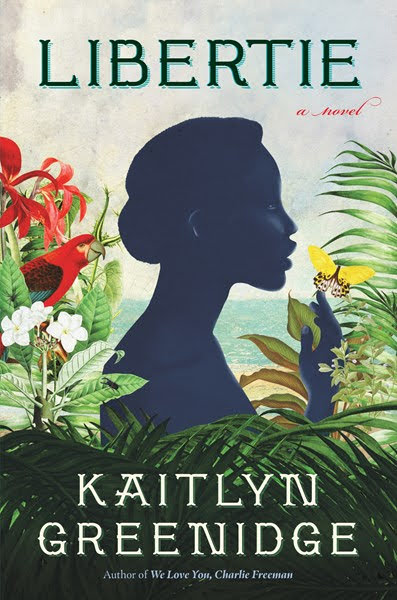
Libertie

Libertie
Title:
  Libertie
Author:  Kaitlyn Greenidge
Publication Information:  Algonquin Books. 2021. 336 pages.
ISBN:  1616207019 / 978-1616207014

Book Source:  I received this book through NetGalley and a publisher's blog tour free of cost in exchange for an honest review.

Opening Sentence:  "I saw my mother raise a man from the dead."

Favorite Quote:  "I do not know what I am or what I will have become by then. I am not sure I ever knew myself. I used to think this was a failing. Something to hide from. How could I be a righteous woman, to serve the world as you did, if I did not know myself? But that seems like sos little of a concern, now. I may not know myself, but I know the loneliness of love. I know that the world is too big to be knowable."

***** BLOG TOUR *****


Review

Libertie - the character and the story - are not what I expect. The book description speaks of a coming of age a story, a journey of self-discovery, and a journey of what it means to be a black woman in the 1860s. In the United States, that is the time of the Civil War, slavery, escape, and the fight for freedom.

Libertie Sampson is a young woman at the time. She was named by her father for "his longing. As a girl, I did not realize what a great burden this was to bear. I was only grateful." She lives with her mother, who is independent, strong, a voice in the community, and a  doctor. The opening sentence of the book speak to her role and the times. The good doctor helped black people escape to a better life; one of the methods was to medicate them such that they appeared virtually dead and to transport them in coffins! This is the opening scene of the book.

The beginning of the book sets up for a powerful, emotional story of the times and of history. The fact that the book description states that it is "inspired by the life of one of the first Black female doctors in the United States" lends itself to that image. I imagine that reference is to Libertie's mother. Unfortunately, this book is not her story although that is a story I wish to read. I want to know her story because she is Black, a woman, a doctor, and a single mother at a time when any one of those individually presents a challenge. All together, I cannot imagine. I want to know her story because of the quiet strength she displays and the strength she tries to pass on to Libertie. I want to know her story because I want to know all she has survived

This is, however, Libertie's story and her elusive search for freedom and independence. Unfortunately, this tale and this characters has a negative tone from beginning to end. I suppose finding her name a burden in the opening paragraphs of the book should have been an indication. Libertie's search for independence throughout the book seems to lead away and be structured as an escape from something rather than a move towards. Each steps seems to be an escape from what comes before. School from her mother's house. Marriage from school and her mother's expectations. Haiti from the United States. And more. At every turn.

At each turn, Libertie finds that what she escapes too is not quite what she envisions and does not provide her with what she seeks. At each turn, her vision of her situation focuses on what it is not rather than what it is. Her independence and happiness remain elusive. Much of the book conveys that negative tone, making it challenging to invest in Libertie as a character or to cheer for her happy ending. Even the ending leaves me doubtful that the next turn in Libertie's life will bring her what she seeks.

About the Author

Kaitlyn Greenidge's debut novel is We Love You, Charlie Freeman (Algonquin Books), one of the New York Times Critics' Top 10 Books of 2016. Her writing has appeared in the Vogue, Glamour, the Wall Street Journal, Elle, Buzzfeed, Transition Magazine, Virginia Quarterly Review, The Believer, American Short Fiction and other places. She is the recipient of fellowships from the Whiting Foundation, the National Endowment for the Arts, the Radcliffe Institute for Advanced Study, the Lewis Center for the Arts at Princeton University and the Guggenheim Foundation. She is currently Features Director at Harper’s Bazaar as well as a contributing writer for The New York Times. Her second novel, Libertie, is published by Algonquin Books and out now.

About the Book

Coming of age as a freeborn Black girl in Reconstruction-era Brooklyn, Libertie Sampson is all too aware that her purposeful mother, a practicing physician, has a vision for their future together: Libertie is to go to medical school and practice alongside her. But Libertie, drawn more to music than science, feels stifled by her mother’s choices and is hungry for something else—is there really only one way to have an autonomous life? And she is constantly reminded that, unlike her mother, who can pass, Libertie has skin that is too dark. When a young man from Haiti proposes to Libertie and promises she will be his equal on the island, she accepts, only to discover that she is still subordinate to him and all men. As she tries to parse what freedom actually means for a Black woman, Libertie struggles with where she might find it—for herself and for generations to come.

Inspired by the life of one of the first Black female doctors in the United States and rich with historical detail, Kaitlyn Greenidge’s new and immersive novel will resonate with readers eager to understand our present through a deep, moving, and lyrical dive into our complicated past. 


Please share your thoughts and leave a comment. I would love to "talk" to you.

Thursday, June 9, 2022

Golden Girl

Golden Girl
Title:
  Golden Girl
Author:  Elin Hilderbrand
Publication Information:  Little, Brown and Company. 2021. 384 pages.
ISBN:  0316420085 / 978-0316420082

Book Source:  I received this book through NetGalley free of cost in exchange for an honest review.

Opening Sentence:  "She receives a message from the front office: a new soul is about to join them, and this soul has been assigned to Martha."

Favorite Quote:  "Nothing in this world feels as good as hope."

In the opening pages of this book, Vivi Howe dies in a hit and run accident. She leaves behind three children, an ex-husband, an upcoming book, and the secrets of a lifetime. A sudden death brings to light all the things left unresolved. Things we think we are going to have time for. Things we think we can get to later. Except that the later is not to be. It also brings to light what priorities were and perhaps what they should have been.

When one of the things left undone is a will, it brings to bear so many more issues. There is a career, wealth, a house, children, alimony for the ex-husband, royalties on books, but no will. I find that challenging to follow, but perhaps. It's a niggling point, but one that can be overlooked in the story.

The plot of this book is itself contrived. Vivi dies, but there is a place in the beyond. She has an assigned guardian. She has a room from which she can watch what happens among the living. Beyond that, she has three "nudges." That's kind of like three wishes. She has the ability, not to completely change things but to "nudge" someone or something in the direction she chooses. She cannot, however, nudge the outcome of that. Where will she use the nudges? 

The beautiful Nantucket summer setting brings forth the idea of a summer beach read. This book avails itself of that setting but then turns from the summer beach read into an attempt to tackle issues plucked from the headlines. Left among the living are Vivi's three children, her children's father, and someone from Vivi's past. Among the living is also the investigation of the culprit behind the hit and run. First and foremost, the chief suspect in the hit and run is a person of color - perhaps the only person of color on Nantucket. Then, there is the daughter who is propositioned at the restaurant at which she works. Is she believed? Is she not believed? There are the wealthy and the not. There are the teenagers with secrets and angst of their own. It's a quick read that tries to do a bit too much.

As you might expect in an Elin Hilderbrand book, by the end, resolutions are reached. Perhaps, most importantly, the children (some of whom are adults) find a way to cope with the loss of their mother. "We honor Mom by offering forgiveness. You know how she treats the characters in her books? She gives them flaws, she portrays them doing horrible things - but the reader loves them anyway. Because Mom loves them. Because they're human."

While not quite a lighthearted summer beach read, the book is a quick, entertaining while it lasts, and leaves the lesson of forgiveness which is always important to remember.


Please share your thoughts and leave a comment. I would love to "talk" to you.

Sunday, June 5, 2022

The Boardwalk Bookshop

The Boardwalk Bookshop
Title:
  The Boardwalk Bookshop
Author:  Susan Mallery
Publication Information:  MIRA. 2022. 432 pages.
ISBN:  0778333299 / 978-0778333296

Book Source:  I received this book through NetGalley and a publisher's blog tour free of cost in exchange for an honest review.

Opening Sentence:  "I thought there'd be more sex."

Favorite Quote:  "Crap happens all the time. You can't avoid it, but you can develop skills to deal with it. Bad things are in your future... I can't tell you what or when, but they're going to happen. The secret isn't to avoid the. The secret is to be strong enough to survive them... I'm suggesting there are ways to strengthen  your sense of self and to add to your emotional tool kit, if you will, so that when the bad stuff happens, you can cope."

***** BLOG TOUR *****


Review

I have to admit. I choose to read this book based simply on the title. The summer, the beach, and a bookshop ... a perfect combination. The fact that it's from Susan Mallery who writes lovely escapist beach reads is an added bonus. This book ticks all the boxes.

Strangers whose paths cross become friends. Friends turn into the family you choose. Bree, Ashley, and Mikki all happen to meet when all three are looking at a property on the beach for their respective businesses. Bree owns a bookstore. Ashley owns and runs a bakery. Mikki has a gift shop. Individually, none of them needs the size of the space, and none of them can afford it on their own. So, these three strangers join forces and decide to colocate their businesses. Three women supporting each other and building each other up, three business owners, three entrepreneurs, three friends. A lovely setup for a story.

In their personal lives, each suffers her own challenges. Bree bears the scars of childhood neglect and a marriage that was based on anything but love. Ashley wonder if the man she thinks is the love of her wants the same things that she does and how far she is willing to compromise. Mikki is divorced but contemplating where her future lies. Tied in are relationships with parents, in-laws, and children.

The book has its share of romance and physical descriptions. Fortunately, the focus stays on the story and the growth of these three women through their individual challenges and in their friendship.

As in other Susan Mallery books, some of the situations are exaggerated. Some of the characters are a little too perfect. Yet, enough of the characters and the events are relatable and ring true. The characters of the three women ring true and keep me engaged through the story even though I know exactly where it is going to end. That is part of what makes it a perfect summer beach reach. I know what to expect, and it delivers.

Also, as with other Susan Mallery books, in the middle of the romance and lightheartedness, the book deals with serious issues. Emotional abuse of a child is perhaps the most significant one in this book. It presents the issue through the lens of an adult who grows up as a neglected child - one who at best is ignored and at worst repeatedly told that her birth was an unexpected surprise and that her presence is an intrusion to her parents' lives. She grows up feeling unlovable and incapable of love. She repeats the patterns of her childhood as an adult. She shuts down emotionally, preferring the lack of feeling to the possible chance of being betrayed again. What I appreciate about this book is that there is no instant solution - through the right guy or the right friends. It depicts the help of professionals and specifically states the work and time that must go into healing. At the same time, it does emphasize the role family and friends can play - for staging an intervention to being there to taking the time to understand and love, flaws and all. This, for me, is the lasting image of this book.

About the Author 

SUSAN MALLERY is the #1 New York Times bestselling author of novels about the relationships that define women's lives—family, friendship and romance. Library Journal says, “Mallery is the master of blending emotionally believable characters in realistic situations," and readers seem to agree—forty million copies of her books have been sold worldwide. Her warm, humorous stories make the world a happier place to live.

Susan grew up in California and now lives in Seattle with her husband. She's passionate about animal welfare, especially that of the two Ragdoll cats and adorable poodle who think of her as Mom.

About the Book

With her unique brand of witty, emotional storytelling, Susan Mallery's latest is a heartfelt tale of friendship between three women brought together by chance who open a bookshop together on the boardwalk of the California beaches and ultimately become one another's family. Fans of Elin Hilderbrand, Robyn Carr and Susan Wiggs will love The Boardwalk Bookshop!

Brought together by chance, Bree, Mikki, and Ashley become fast friends and open up a beachfront bookshop together, bringing together their three different businesses. To celebrate, each Friday at sunset they pop open champagne on the beach and enjoy the sunset together. Little did they know that that chance meeting and this simple ritual would make them one another’s family.

Bree owns the bookshop. Funny that she can’t stand authors. They’re far too demanding. But when NYT bestselling author Harding Burton, the memoirist who wrote about being paralyzed as a teenager and how he fought his way back, comes in, Bree never expected to actually like him. But anything beyond casual sex is out of the question for her. She trusts no one—a brutal first marriage and a painful childhood taught her well. Still as much as she wants to walk away, she can’t quite do it…

Ashley, Harding’s brother, owns the muffin shop and she has her own problems. She’s been happily in love with her boyfriend, Seth, for eight years. He’s thoughtful, supportive, kind, generous…but he hasn’t proposed and, she can’t hold it in any longer. When he announces that marriage isn’t for him, she’s shocked. And as much as she wishes this was enough, the truth is that she wants to be married. But what now?

And Mikki, the gift shop owner, is getting a second chance. She married her high school sweetheart, but three kids and completely different interests made them drift apart until they divorced a few years ago. They’re still close for the kids, but when someone new enters her life, he makes her feel appreciated and alive. Suddenly Mikki’s ex is making her dinner and asking her advice and Mikki must choose between the man she loved and let go of—and a chance for a brand new beginning.

Q&A with Susan Mallery
What are your Favorite: food, beverage, pet, place visited, place you would like to visit, car, etc?
  • Favorite food: Chocolate and bread are tied for first place.
  • Favorite beverage: wine—I’m a big fan of Washington wines, which is why I wrote The Vineyard at Painted Moon, a book that came out in 2021.
  • Favorite pet: A mom isn’t supposed to have favorites, but I’ll confess just to you—Alex, my cat, is my guy. He always wants to be close to me, and I love that, too. You’ll often see him when I do virtual events, usually demanding dinner and affection, in that order. I do love my dog Kelli, too, but she’s more into her daddy than she is me.
  • Favorite place visited: My husband and I enjoy cruises. We’ve visited so many wonderful places, but one country whose beauty surprised me was Estonia. It’s filled with historical character and charm, and the people are warm and delightful.
  • I also love visiting my hometown, Los Angeles. That’s why I set The Boardwalk Bookshop in LA, so I could spend a few months in California—in my imagination, that is.
  • Place I would like to visit: Our next cruise will be to the British Isles, and I’m very excited. I’ll share pictures on Facebook and Instagram. I’m @susanmallery in both places, if you’d like to travel there vicariously.
  • Favorite car: My husband’s a total car guy. I’m mostly indifferent, though there are features I love. Heated seats are very nice, but a heated steering wheel is true luxury. When I need to know what kind of car a character would drive, I describe the character to Mr. Mallery and let him decide.
Tell us about your latest book, who is the main character(s) and what can we expect when we pick it up?
The Boardwalk Bookshop is about three strangers—Bree, Mikki and Ashley—who lease a beachfront retail location together and the friendship that blossoms among them. Bree owns the bookshop, Mikki the gift shop, and Ashley the bakery. I wanted to explore the transformative power of friendship. Because they have one another, these women are empowered with the strength and courage to change their lives. The Boardwalk Bookshop is an emotional, uplifting story that you’ll finish with a happy sigh. And I hope it will inspire you to strengthen your own bonds of friendship.

Bree is one of the most wounded characters I’ve ever written—hurt by neglectful parents when she was young, and by repeating that pattern with the man she married. Now widowed, she’s determined to protect herself at all costs. Then Ashley’s brother comes to her bookshop, a motivational author and adventurer who has inspired the world with his story. . . and teaches her that loneliness is a choice she doesn’t have to make. If only she can find the courage to risk her heart again.

Mikki is kind of rocking her divorce, or so she thinks. She and her ex have remained friends, and the whole family still celebrates holidays together. But when she starts dating again and meets a guy with real potential, things get messy fast. Mikki is one of those women who goes into mom mode for anyone in need of nurturing. She also has a wicked sense of humor and a very special, secret relationship that I know will make readers laugh. And maybe blush.

The youngest of the three friends, Ashley is deeply in love with the guy of her dreams. And he loves her, too! Finally, she found The One. Except she’s about to discover that Seth doesn’t believe in marriage. He believes that love is stronger when people make a choice every day to stay together. Can she be happy with him forever, even if she never becomes his wife?

Which of the characters in The Boardwalk Bookshop would you want to have a drink/coffee and a chat with?
I love them all, but if I have to choose, I’ll go with Bree. She’s the most complicated and the most snarky, and I find snarky, complicated women endlessly amusing. Plus, she owns a bookshop! Hello!

Buy Links

Bookshop.org: https://bookshop.org/books/the-boardwalk-bookshop-9780778333296/9780778333296
Amazon: https://www.amazon.com/gp/product/0778386082?ie=UTF8&tag=wwwsusanmalle-20&linkCode=as2&camp=1789&creative=9325&creativeASIN=0778386082
Barnes & Noble: https://www.barnesandnoble.com/w/the-boardwalk-bookshop-susan-mallery/1140127614?ean=9780778386087
Books-a-Million: https://www.booksamillion.com/p/Boardwalk-Bookshop/Susan-Mallery/9780778386087?id=8318065423495
Kindle: https://www.amazon.com/gp/product/B09FFGG6YS?ie=UTF8&tag=wwwsusanmalle-20&linkCode=as2&camp=1789&creative=9325&creativeASIN=B09FFGG6YS
Nook: https://www.barnesandnoble.com/w/the-boardwalk-bookshop-susan-mallery/1140127614?ean=9780369718433
Google Play: https://play.google.com/store/books/details/Susan_Mallery_The_Boardwalk_Bookshop?id=KBZBEAAAQBAJ
Apple Books: https://books.apple.com/us/book/the-boardwalk-bookshop/id1584336225
Kobo: https://www.kobo.com/us/en/ebook/the-boardwalk-bookshop
Walmart: https://www.walmart.com/ip/The-Boardwalk-Bookshop-Paperback-9780778386087/560857236
Target: https://www.target.com/p/the-boardwalk-bookshop-by-susan-mallery/-/A-84881665?preselect=84397825

Social Links

Twitter: @susanmallery
Facebook: @susanmallery
Instagram: @susanmallery
Author website: https://www.susanmallery.com/


Please share your thoughts and leave a comment. I would love to "talk" to you.